Commercial Property Tax in Florida
Owning commercial property in Florida can feel like a fantastic investment opportunity, with the Sunshine State's booming economy and population growth. However, many commercial property owners often find themselves grappling with unexpectedly high property tax bills, leading to significant stress and uncertainty about their annual expenses. This comprehensive guide is designed to demystify the intricacies of commercial property tax in Florida, helping you understand how it's calculated, what factors influence your bill, and proactive strategies to manage these crucial costs effectively.
Understanding Florida's Commercial Property Tax Landscape
Florida's approach to property taxation, while sharing some common threads with residential property, has distinct characteristics for commercial assets. It’s not just about the brick and mortar; it’s about location, potential income, and what the market dictates for similar business operations. For anyone thinking of investing in a new storefront in Miami's bustling Brickell area, a warehouse in Jacksonville, or an office complex in downtown Orlando, understanding these nuances upfront can save a lot of headaches and unexpected costs down the line.
How Commercial Property is Assessed in Florida
When it comes to commercial property, the assessment process is far more complex than for a typical single-family home. Florida law mandates that all property be assessed at its "just value," which essentially means market value. However, arriving at that figure for a commercial building involves a deep dive into several valuation methods, often requiring the expertise of professional appraisers working for the local property appraiser's office. They consider everything from the property's physical characteristics, such as square footage, age, and condition, to its economic attributes, like lease agreements, operating expenses, and potential for income generation. Unlike residential properties, which often rely heavily on comparable sales, commercial properties bring in more sophisticated analyses because their value is so closely tied to their income-generating potential.
Key Players in Florida's Property Tax System
It's easy to feel like you're alone when facing a property tax bill, but there are several key players involved in the Florida system. First up is your County Property Appraiser. This elected official is responsible for identifying and valuing all real estate in the county, including every commercial parcel. Their office sets the assessed value, which is the cornerstone of your tax bill. Next, you have the various taxing authorities: cities, counties, school districts, water management districts, and special assessment districts. Each of these entities sets its own millage rate – the tax rate applied to your property's assessed value – to fund their services. Finally, there's the Value Adjustment Board (VAB), which acts as an appeals body if you disagree with the property appraiser's valuation. Understanding these roles is crucial for anyone trying to navigate the system, whether you're managing a small retail shop or a large industrial complex. If you're looking to understand how this all fits together, our guide on Who Sets Property Tax Rates? (County, School, City Levies) can provide more clarity on the various jurisdictions.
Navigating the Valuation Process for Commercial Properties
The "just value" determination for commercial properties isn't a one-size-fits-all approach. Property appraisers employ three main methods, often using a combination of them, to arrive at an accurate assessment. This is where things get interesting, especially for investors and business owners who see their properties not just as structures, but as active assets in their portfolios. Each method looks at the property from a different angle, offering a comprehensive picture of its worth.
Income Approach to Valuation
For many income-producing commercial properties, like apartment buildings, office spaces, or retail centers, the income approach is often the most significant valuation method. This method basically asks: "What could this property generate in income, and what would an investor pay for that income stream?" Appraisers estimate the potential gross income, subtract vacancies and operating expenses, and then apply a capitalization rate (cap rate) to the resulting net operating income (NOI). The cap rate reflects the rate of return an investor would expect for a property of that type and risk level. For instance, a Class A office building in downtown Tampa might have a lower cap rate than an older strip mall in a less developed area, reflecting different risk and return expectations. This approach really highlights how the financial performance of your commercial property directly impacts its assessed value, making careful financial tracking, possibly with tools like Stessa, incredibly important for demonstrating accurate income and expenses.
Sales Comparison Approach for Commercial Properties
While less dominant than for residential properties, the sales comparison approach still plays a role in valuing commercial real estate. This method involves analyzing recent sales of comparable commercial properties in the same market. However, "comparable" for commercial means more than just similar size or location. Appraisers look for properties with similar zoning, use, age, condition, tenant mix, and even lease terms. It’s not always easy to find perfectly matched commercial comps, especially for unique properties or in less active markets. A recently sold office building might be similar in size, but if it was fully leased with long-term tenants while yours has significant vacancies, the comparison isn't straightforward. This method provides market context, but its effectiveness can be limited by the availability of truly comparable commercial transactions. Understanding how this differs from how a typical home is valued can be crucial; our article on Tax Assessed Value vs Appraised Value can shed light on these differences.
Cost Approach to Valuation
The cost approach to valuation estimates what it would cost to replace the commercial property today, minus any depreciation. This method is particularly useful for newer buildings, special-purpose properties (like a manufacturing plant or a hospital), or properties where income and sales data are scarce. Appraisers calculate the cost of constructing a new, similar building, add the value of the land, and then subtract any forms of depreciation – physical deterioration, functional obsolescence (e.g., outdated design), and external obsolescence (e.g., a new highway diverting traffic away). While seemingly straightforward, estimating replacement costs and accurately assessing depreciation can be complex. For example, the cost of materials and labor for a new retail space in Naples today might be significantly different than it was five years ago, impacting this valuation. If you're dealing with new construction, you might also find our guide on New Construction Property Tax Explained helpful.
Key Differences: Commercial vs. Residential Property Tax in Florida
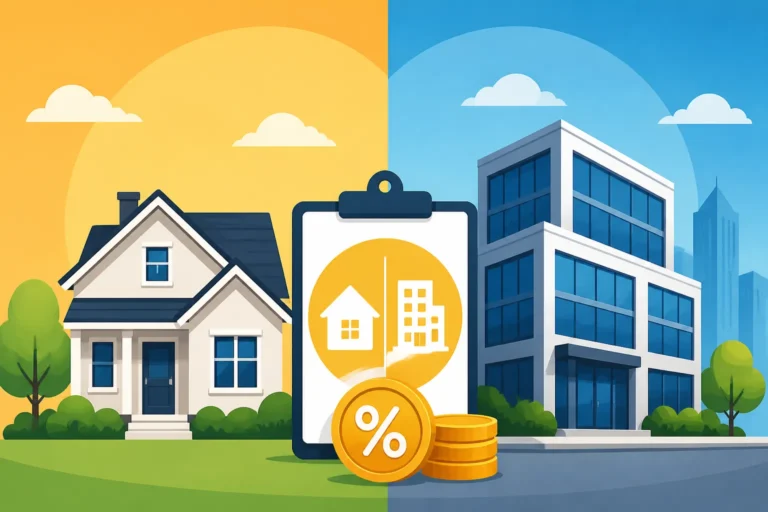
It’s easy to assume that property taxes are property taxes, no matter the type of real estate. But in Florida, the differences between how residential and commercial properties are treated can be quite significant, especially when it comes to potential tax relief and the assessment process itself. For business owners, understanding these distinctions is paramount to avoiding surprises and planning financially.
Homestead Exemption Doesn't Apply to Commercial Properties
This is perhaps the biggest and most disheartening difference for commercial property owners. While Florida residents who own and reside in their homes can claim a significant homestead exemption (potentially up to $50,000 off their assessed value), commercial properties are entirely ineligible for this benefit. This means your commercial property's full assessed value is subject to taxation from dollar one, offering no initial discount like a primary residence would. This lack of exemption significantly contributes to generally higher effective property tax rates for commercial properties compared to owner-occupied residential ones. It’s a crucial point to remember when calculating potential returns on a commercial investment in Florida. You can learn more about this and other exemptions in our comprehensive Homestead Exemption: Complete State-by-State Guide.
Higher Scrutiny and Complexity for Commercial Parcels
Beyond the lack of exemptions, commercial properties often face a higher level of scrutiny and a more complex assessment process. Residential assessments can often be more standardized, relying heavily on mass appraisal techniques and readily available sales data for similar homes in a subdivision. Commercial properties, however, are far more diverse. Each office building, retail center, or industrial warehouse has unique characteristics, lease agreements, operating histories, and market positions. Appraisers must consider these individual financial and physical attributes in much greater detail, often leading to more subjective (though still legally defensible) valuations. This complexity can make challenging an assessment more difficult, but it also means there's potentially more room for argument if you believe your assessment is incorrect. This is where meticulous record-keeping, perhaps aided by property management software like Stessa, can become your best friend, offering clear data to support your claims.
Strategies for Managing and Potentially Lowering Your Commercial Property Tax Bill
Facing a hefty commercial property tax bill can be daunting, but it's not a set-in-stone figure. There are proactive steps you can take to manage your tax burden and, in some cases, even lower it. It's all about being informed, organized, and willing to engage with the system. Think of it as another aspect of smart asset management.
Understanding Your Notice of Proposed Property Taxes (TRIM Notice)
Every August, Florida property owners receive a "Notice of Proposed Property Taxes," commonly known as the TRIM (Truth in Millage) Notice. This isn't your actual tax bill, but it's arguably more important. It outlines the proposed taxable value of your commercial property, the millage rates proposed by each taxing authority, and the estimated taxes you'll owe. Crucially, it also tells you the deadline and process for protesting your assessment. This notice is your first and best opportunity to review the property appraiser's valuation. Don't just glance at it and file it away! Scrutinize the proposed value. Does it seem realistic given current market conditions, your property's condition, and its income potential? If you disagree, this notice is your call to action. You can often find a wealth of information about how to read this notice on your county property appraiser's website.
The Protest and Appeal Process in Florida
If you believe your commercial property's assessed value is too high, Florida provides a formal protest and appeal process. It typically starts with an informal review with the property appraiser's office. This is your chance to present evidence that their valuation is incorrect. You might use recent sales of truly comparable commercial properties, income and expense statements (especially if using tools like Stessa to track these), or even an independent appraisal. If you can't reach an agreement informally, you can file a petition with the Value Adjustment Board (VAB). The VAB is an independent body that holds formal hearings where you present your case to a special master or the board itself. This process has strict deadlines, usually 25 days after the mailing of the TRIM Notice, so acting quickly is essential. Successfully appealing property taxes requires solid evidence, patience, and a clear understanding of the process. Our guide on How to Appeal Property Taxes: Complete Guide offers an in-depth look at this critical process.
Leveraging Technology for Property Tax Management
In today's digital age, managing commercial property taxes no longer has to be a manual, spreadsheet-heavy nightmare. Technology offers powerful solutions that can help property owners stay organized, track vital financial data, and even identify potential discrepancies in their assessments. Property management software and dedicated tax management platforms are designed to streamline these processes.
Imagine trying to keep track of every repair, every lease agreement, every vacancy, and every rent payment across multiple commercial units or properties. It quickly becomes overwhelming. This is where platforms like Stessa shine. By automating income and expense tracking, generating financial reports, and keeping all your property documents in one place, Stessa provides the robust data needed to support a property tax appeal. You can easily pull up accurate net operating income reports or highlight significant expenses that might indicate a lower value than the appraiser's estimate. This kind of organized data is gold when you're trying to demonstrate to a property appraiser or the VAB why their assessment might be off.
Even if you're not planning an appeal, using such tools helps you understand your property's financial performance better, making you more informed about its true market value and potential tax implications. When it comes to understanding how your commercial property is performing, and in turn, how that might affect its tax assessment, having a clear, accurate financial picture is indispensable. This proactive approach ensures you're never caught off guard and always have the necessary documentation at your fingertips.
Summary of Commercial Property Tax Differences
To help visualize some of the key distinctions we've discussed, here's a handy comparison between typical residential and commercial property tax considerations in Florida:
| Feature | Residential Property (Primary Residence) | Commercial Property |
|---|---|---|
| Homestead Exemption | Yes, significant exemption available | No homestead exemption available |
| Assessment Focus | Primarily sales comparison, mass appraisal | Income, sales comparison, cost approaches (complex) |
| Growth in Value Cap | "Save Our Homes" cap (3% or CPI, whichever is lower) | No growth cap; assessed value can increase significantly year to year |
| Complexity of Valuation | Generally simpler, more standardized | Highly complex, individual analysis required |
| Data for Appeals | Comp sales, condition reports | Income/expense statements, independent appraisals, market studies |
| Effective Tax Rate | Often lower due to exemptions and caps | Generally higher due to lack of exemptions and potential for higher valuations |
This table clearly illustrates why commercial property owners need to be particularly diligent and informed about their property tax obligations and rights.
Disclaimer
Please remember that this guide provides general information about commercial property tax in Florida. Property tax laws and regulations are complex and can change. The information herein is not intended as legal or financial advice. Always consult with a qualified property tax consultant, attorney, or financial advisor for advice tailored to your specific situation.