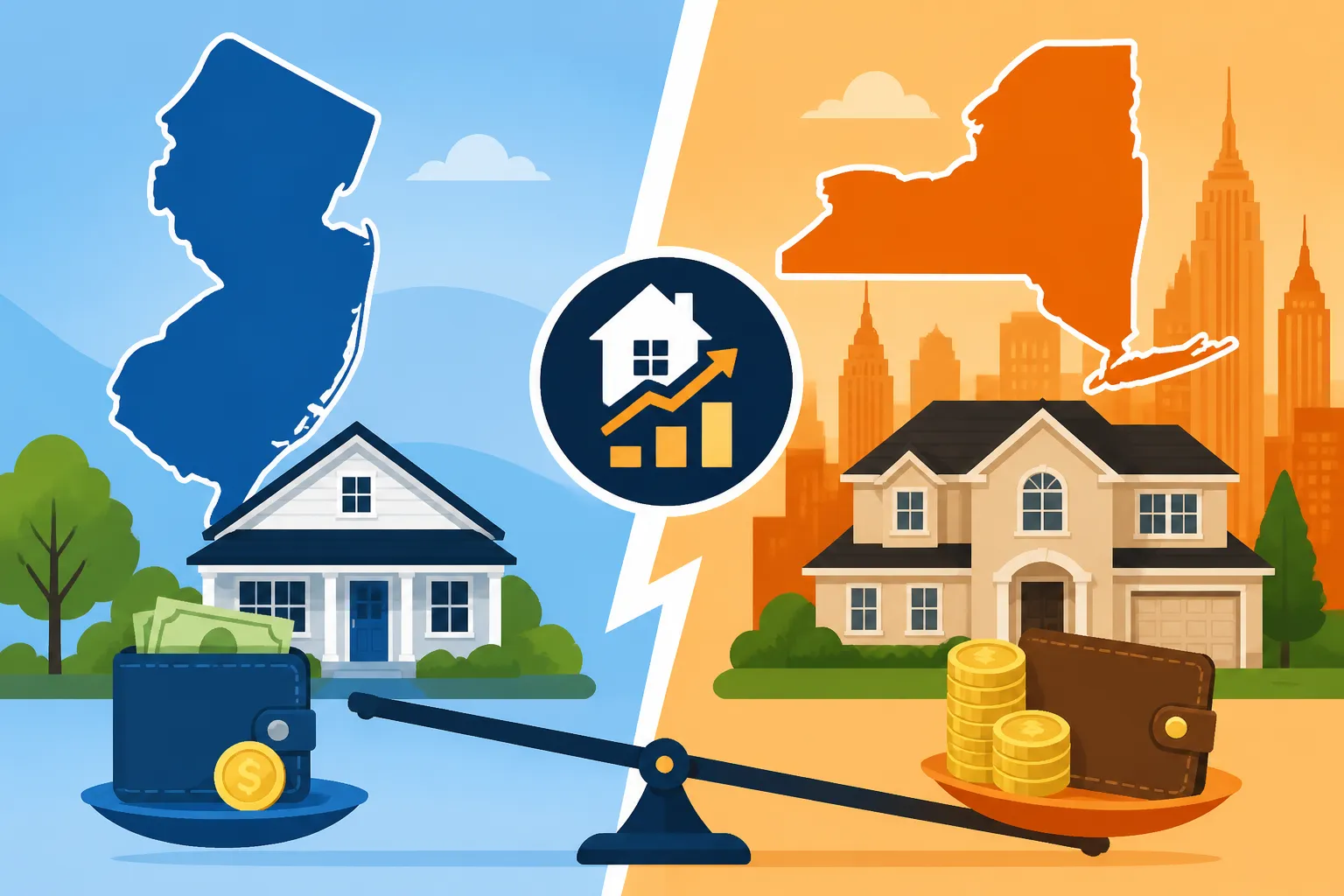
Property Taxes: New Jersey vs New York Compared
For anyone looking at homes, whether it's your first house or your forever home, the question of property taxes can feel like a giant, looming shadow. It's a huge financial commitment, often one of the biggest parts of your monthly housing expense, and trying to understand how it varies from state to state can be downright frustrating. This guide is here to shed light on exactly that, specifically tackling the nuances of property taxes when comparing two distinct and often-discussed states: New Jersey and New York.
Understanding the Landscape of Property Taxes in New Jersey
New Jersey has a reputation, and frankly, it's earned, for having some of the highest property taxes in the entire United States. When you're weighing your options for buying a home, this isn't just a number on a spreadsheet; it translates directly into your quality of life and what you can afford. It's crucial to really dig into why this is the case and how the system functions.
How New Jersey's Property Tax System Works
In New Jersey, property taxes are primarily levied at the local level. This means your tax bill isn't set by some distant state agency, but rather by the individual municipalities and counties where you live. This local control, while fostering community engagement and direct accountability for services, also leads to significant variations in tax rates even between neighboring towns. The core components of your New Jersey property tax bill are typically broken down into three main categories: municipal, school, and county taxes. The municipal portion covers local services like police, fire, public works, and general administration. The school portion, which often makes up the largest percentage of your bill, funds the local public school districts. Then there's the county portion, which goes towards county-wide services such as community colleges, county roads, and certain judicial services. Each of these entities sets its own budget and then determines the tax levy needed from property owners to fund those budgets.
Your individual property tax is calculated by multiplying your home's assessed value by the combined tax rate (often expressed as a "mill rate"). What is a Mill Rate? (Millage Explained) is a good resource if you want to understand this more deeply. The assessed value is typically a percentage of your home's market value, though the exact percentage can vary. Municipalities are required to conduct revaluations or reassessments periodically to ensure property values reflect current market conditions, though the timing of these can differ. It's not uncommon for homeowners to feel blindsided when a reassessment drastically changes their perceived value, directly impacting their tax bill.
Key Factors Driving High Property Taxes in New Jersey
So, why are these taxes so notoriously high? There isn't one single answer, but rather a perfect storm of contributing factors. One of the biggest drivers is the heavy reliance on property taxes to fund local public services, particularly education. Unlike some states that contribute a larger share of school funding from state income or sales taxes, New Jersey places a substantial burden on local property owners. This means that communities with excellent school districts, which are often a huge draw for families, tend to have higher property taxes to maintain that quality. If you want to dive deeper, we have an article on Why Are New Jersey Property Taxes So High?
Another significant factor is the dense population combined with a large number of independent municipalities. New Jersey has over 560 municipalities, many of them small, each with its own administrative overhead – its own mayor, council, police force, fire department, and public works department. This fragmented governance can lead to inefficiencies and duplicated services across small geographic areas, all funded by local property taxes. The cost of living and providing services in the densely populated, affluent areas close to major metropolitan hubs like New New York City and Philadelphia also plays a huge role. Higher wages for public employees, increased demand for services, and the sheer cost of infrastructure maintenance in established, older communities all contribute to the bottom line.
Relief Programs Available in New Jersey
Despite the high rates, New Jersey does offer several programs aimed at providing some relief to eligible homeowners. One of the most significant is the ANCHOR program (Affordable New Jersey Communities for Homeowners and Renters), which replaced the old Homestead Rebate. This program provides direct property tax relief to eligible homeowners and renters based on income and residency requirements. It’s a retroactive benefit, meaning you apply for a credit for the previous tax year. Eligibility and benefit amounts can change, so it's always wise to check the state's Division of Taxation website for the latest details.
Beyond the ANCHOR program, there are also specific exemptions for certain groups. Seniors and disabled individuals, for instance, may qualify for a Property Tax Freeze for Seniors: Which States program, which essentially caps the amount they pay, preventing it from increasing beyond a certain base year amount, provided they meet income and residency requirements. Veterans, and their surviving spouses, can also apply for a Property Tax Exemption for Veterans in New Jersey that offers a deduction from their annual property tax bill. These programs, while not eliminating the property tax burden, can certainly provide some much-needed financial breathing room for those who qualify, and it's always worth looking into them. For a comprehensive overview of various relief options, check out our guide on Property Tax Relief Programs in New Jersey.
Navigating Property Taxes in New York State
Across the Hudson, New York State presents a different, though equally complex, property tax landscape. While its overall effective property tax rate might be lower than New Jersey's in some areas, it still ranks among the highest in the nation. Understanding New York's system means grappling with its unique blend of state oversight and local autonomy, all while dealing with some of the most expensive real estate markets in the world.
The Structure of Property Taxation in New York
New York's property tax system is also deeply rooted in local administration, with taxes levied by counties, cities, towns, villages, and school districts. This multi-layered approach means your total tax bill is a sum of contributions to various taxing authorities. Just like in New Jersey, school taxes usually constitute the largest portion of a New York homeowner's bill, followed by county and municipal taxes. Each local government unit adopts a budget and determines the amount of revenue needed from property taxes to meet that budget. This is then translated into a tax rate applied to your home's assessed value.
The assessment process in New York is generally overseen by elected or appointed assessors at the town or city level. These assessors are responsible for valuing all real property within their jurisdiction. Most properties are assessed at a uniform percentage of market value, which can be anywhere from 6% to 100%, depending on the assessing unit. This uniform percentage is known as the "level of assessment." What is critical to remember is that an increase in your assessed value doesn't automatically mean a corresponding increase in your tax bill, especially if the local taxing authorities don't increase their spending. Conversely, even if your assessed value stays the same, an increase in local government or school district spending can still push your taxes up. We have a detailed guide on How Are Property Taxes Calculated? if you're curious about the mechanics.
Factors Influencing Property Taxes in New York
Several factors contribute to the property tax situation in New York. One prominent factor is the cost of living and operating within a state that includes New York City and its heavily populated surrounding suburbs. These areas have some of the highest property values and demand for public services, which translates into higher costs that are often passed on to property owners. The state's aging infrastructure also requires significant funding for maintenance and upgrades, again largely shouldered by local property taxes. Furthermore, New York, like New Jersey, heavily relies on property taxes to fund its public education system. The quality of schools, particularly in sought-after suburban areas, directly correlates with higher property tax levies.
Another unique aspect is the existence of numerous small taxing jurisdictions. While New York doesn't have as many separate municipalities as New Jersey, it still features a complex web of towns, villages, and special districts (like fire, water, or library districts), each with its own budget and taxing authority. This can create a patchwork of different tax rates even within a single county, making it challenging for homeowners to understand their total liability. The New York Property Tax Rate Explained article offers a deeper dive into these complexities.
Property Tax Relief and Exemptions in New York
New York State recognizes the burden of property taxes and offers several programs to help homeowners, particularly those with fixed incomes or special circumstances. The most widely known and utilized program is the STAR (School Tax Relief) program. This program provides an exemption from school property taxes for eligible homeowners. There are two main types: Basic STAR, available to homeowners regardless of age with incomes below a certain threshold, and Enhanced STAR, which offers a larger exemption for senior citizens (age 65 and older) who meet specific income requirements. For more information on how this works, check out STAR & School Tax Relief in New York.
Beyond STAR, New York also offers specific exemptions for senior citizens, veterans, and individuals with disabilities. The Senior Citizens' Exemption (SCE) provides a reduction in the assessed value of residential property owned by qualifying seniors, contingent on income levels and other criteria. Similarly, the Veterans Exemption grants a reduction in assessed value for qualifying veterans. There are also agricultural exemptions for farmland, designed to preserve agricultural land by basing its assessment on agricultural value rather than market value. These exemptions can significantly reduce a homeowner's taxable assessment, leading to lower property tax bills, but they require active application and often annual renewal. For a comprehensive overview of age-based relief, you can read about Senior & Over-65 Property Tax Exemptions and Freezes.
Direct Comparison: New Jersey vs. New York Property Tax Rates
When we talk about property taxes, it's easy to get lost in averages or broad generalizations. But the reality for homeowners is far more granular. Comparing New Jersey and New York requires looking beyond just the sticker price and understanding the underlying mechanisms and what they mean for your wallet.
Effective Property Tax Rates and Their Impact
The "effective property tax rate" is often the most telling metric for homeowners, as it represents the amount of property tax paid as a percentage of a home's actual market value. New Jersey consistently holds the top spot for the highest effective property tax rate in the nation. This means that, on average, New Jersey homeowners pay a larger percentage of their home's value in annual property taxes than residents in any other state. For example, a home valued at $400,000 in a typical New Jersey town might incur an annual property tax bill upwards of $8,000-$10,000, or even more in some desirable communities.
New York's effective property tax rates, while still high nationally, generally fall behind New Jersey's on a statewide average. However, this is heavily skewed by the vast geographical differences within New York. Upstate New York, with its lower property values, tends to have lower absolute tax bills, even if its nominal rates (the actual rate applied to assessed value) can still be high. Conversely, the suburban counties surrounding New York City, such as Westchester, Nassau, and Suffolk Counties, often see effective rates and absolute tax bills that rival, and sometimes exceed, the highest in New Jersey. The article on Effective vs Nominal Property Tax Rate Explained clarifies these distinctions further. The sheer difference in property values between, say, Warren County, New Jersey, and Bergen County, New Jersey, or between Allegany County, New York, and Westchester County, New York, means that even similar nominal rates can result in wildly different tax bills.
Local Control and How It Shapes Your Bill
Both states grant significant autonomy to local jurisdictions in setting and collecting property taxes, but the impact of this local control manifests differently. In New Jersey, the municipal fragmentation is a key driver. With so many independent towns, each funding its own full suite of services and schools, competition for residents and a desire to maintain high-quality amenities often push tax levies higher. If a town wants to improve its schools, enhance its police force, or maintain pristine public parks, the primary funding mechanism is almost always the local property tax. This leads to intense focus on local budgets and the associated tax impact.
New York also has strong local control, but its state aid formulas for education can sometimes cushion the blow for some districts, though this is a complex and often debated topic. However, the prevalence of distinct school districts in New York, often separate from municipal governments, means that school tax levies are often a significant and independently managed component of your bill. This layered approach means homeowners are paying into several distinct buckets, each controlled by a different local board. Understanding How Property Tax Levies and Rates Are Set can help decipher this complex interplay.
The Impact of Property Values on Taxation
It's a common misconception that high property values automatically mean astronomical property taxes. While there's a correlation, it's not a direct one-to-one relationship. In both New Jersey and New York, your property tax bill is a product of your home's assessed value and the local tax rate. A town with very high property values might have a relatively low tax rate (mill rate) to generate the same amount of revenue as a town with lower property values but a higher tax rate.
However, in areas where property values are rapidly appreciating, like many desirable suburbs in both states, homeowners can face a double whammy: their assessed value goes up due to market appreciation, and if local budgets also increase, the tax rate may not drop enough to offset the higher assessment. This is where the concept of Property Tax Assessment & Reassessment Explained becomes crucial. Regular reassessments are designed to keep property values in line with market realities, but they can lead to significant jumps in taxable value and, consequently, your tax bill.
Here's a table summarizing some key differences:
| Feature | New Jersey | New York |
|---|---|---|
| Effective Tax Rate | Consistently highest in the nation (avg. around 2.47% in 2023-2024) | High nationally, but lower statewide average than NJ (avg. around 1.40% in 2023-2024), with wide regional variations |
| Primary Funding Source | Heavy reliance on local property taxes for schools and municipal services | Significant reliance on local property taxes for schools, but state aid formulas play a role; distinct school districts often set their own levies |
| Assessment Frequency | Periodic revaluations/reassessments by municipalities, aiming for 100% market value (though not always achieved) | Regular assessments by town/city assessors, typically at a uniform percentage of market value (Level of Assessment) |
| Key Relief Program | ANCHOR program (Affordable New Jersey Communities for Homeowners and Renters) | STAR program (School Tax Relief – Basic and Enhanced) |
| Municipal Structure | High number of smaller, independent municipalities, each with its own services and tax levies | Towns, cities, villages, and special districts; school districts often operate independently of municipal governments |
| Geographic Variation | High taxes across most of the state, especially in desirable suburban areas | High taxes in NYC suburbs (Westchester, Nassau, Suffolk), lower in many upstate regions due to lower property values |
(Note: Average effective tax rates are estimates and can vary annually based on numerous factors including changes in property values and local budgets.)
Practical Considerations for Homeowners and Buyers
Deciding where to live involves so much more than just a house price. When considering New Jersey versus New York, especially with property taxes in mind, it really comes down to understanding the full financial picture and how it impacts your long-term goals. It's about being prepared, not just for the purchase, but for the ongoing costs of homeownership.
Moving Between States: What to Expect
If you're moving from New York to New Jersey, or vice-versa, your property tax experience will likely change significantly, even if you move just a few miles across the state line. For someone moving from a high-tax New York suburb like Westchester County to a comparable New Jersey town, the total property tax bill might feel similar in dollar amount, but the effective rate could be noticeably higher in New Jersey. You'll need to research specific municipalities carefully. The average effective property tax rate in New Jersey is generally higher, so you might find your home in New Jersey carries a greater tax burden relative to its market value compared to an equivalent home in many parts of New York.
Conversely, moving from, say, a high-tax New Jersey town to an upstate New York community might feel like a huge relief on your wallet. However, it's crucial to look at the entire cost of living, including income taxes, sales taxes, and other local fees, as these also contribute to your overall financial burden. Furthermore, the property tax calendar and payment schedules can differ. For instance, in New Jersey, property taxes are generally paid quarterly, while in New York, they might be paid in multiple installments to different taxing authorities (county, town, school). Knowing how to Read Your Property Tax Bill will be an essential skill no matter where you live. This means understanding when payments are due and to whom. Getting familiar with Property Tax Due Dates by State is a great first step.
Strategies for Managing Your Property Tax Burden
No matter which state you choose, there are proactive steps you can take to try and manage your property tax burden. The first and most critical step is to understand your assessment. Is your home's assessed value truly reflective of its market value? Do comparable homes in your area have similar assessments? If you believe your assessment is too high, you have the right to appeal it. Our comprehensive guide on How to Appeal Property Taxes: Complete Guide can walk you through the process, which usually involves presenting evidence to your local assessor that your home is overvalued compared to similar properties or that there are errors in your assessment.
Another strategy is to diligently apply for any and all exemptions or relief programs for which you might be eligible. Whether it's the ANCHOR program in New Jersey, the STAR program in New York, or specific exemptions for seniors, veterans, or individuals with disabilities, these programs can significantly reduce your tax liability. Don't assume you automatically receive them; you usually need to apply, and sometimes reapply annually. Beyond direct appeals and exemptions, keeping track of local budget discussions is important. Attending town or school board meetings, or at least reviewing their proposed budgets, can give you insight into why your taxes might be increasing and provide opportunities to voice your concerns.
Common Misconceptions to Avoid
One of the biggest misconceptions is that a higher-priced home always means proportionally higher taxes. While assessed value is a component, the actual tax rate set by local authorities can vary widely. A $500,000 home in a town with a lower tax rate might have a lower tax bill than a $400,000 home in a town with a very high tax rate. Don't just look at market values; dig into the effective tax rates for specific neighborhoods.
Another common mistake is assuming that property taxes are fixed once you buy a home. This is rarely the case. Property taxes can and do increase over time due to reassessments that capture market appreciation and increases in local government or school district spending. Homeowners often get frustrated when their taxes go up even if they haven't made improvements to their home. This is usually due to market-wide appreciation reflected in a reassessment or an increase in the local tax levy to fund public services. The key is to factor potential increases into your long-term financial planning. Researching Property Tax Trends 2026 can give you a better sense of historical changes. Finally, don't confuse your property's market value with its tax-assessed value. While related, they are not always the same, and understanding this distinction is key to a successful tax appeal. For more on this, check out Assessed Value vs Market Value vs Taxable Value.
Disclaimer
Please remember that property tax laws, rates, and exemption programs are subject to change by state and local authorities. The information provided in this article is for general informational purposes only and does not constitute financial, legal, or tax advice. Always consult with a qualified tax professional, financial advisor, or local tax assessor's office for advice tailored to your specific situation.