How Are Property Taxes Calculated?
Imagine opening your mailbox on a crisp Tuesday afternoon, only to find a property tax bill that looks more like a mortgage statement than a local levy. For most homeowners, the math behind that number feels like a cryptic riddle wrapped in government jargon. This guide demystifies exactly how local authorities calculate your property taxes, helping you understand every variable from assessment to the final bill.
Understanding the Foundation: Market Value vs. Assessed Value
The journey of your property tax bill begins long before it hits your kitchen table. It starts with a valuation process that often leaves homeowners scratching their heads. You might see your home listed for $500,000 on a real estate app, but your tax bill shows a completely different number. This discrepancy isn't necessarily an error; it is the fundamental difference between what a buyer might pay and what the government says is taxable.
The Role of the County Assessor
The county assessor is a figure often misunderstood by the public. Many people imagine a lone individual walking from house to house with a clipboard, peering over fences to see if you’ve added a new patio. In reality, modern assessment is a massive data-driven operation. In places like Maricopa County, Arizona, or Harris County, Texas, assessors manage hundreds of thousands of parcels using sophisticated software. Their primary goal isn't to find the highest possible value, but to ensure that everyone is paying their "fair share" based on the current local real estate market. They look at "arms-length transactions"—sales between unrelated parties—to determine what a willing buyer would pay a willing seller.
When the assessor looks at your property, they are considering several key factors: the age of the structure, the square footage, the number of bedrooms and bathrooms, and the specific neighborhood data. They also track building permits. If you recently finished a basement in a suburb like Naperville, Illinois, the town's building department likely shared that permit with the assessor’s office. This triggers an update to your property’s profile. For a deeper look at this process, you can explore Property Tax Assessment & Reassessment Explained to see how these updates impact your bottom line over time.
Mass Appraisal Techniques
Because it is impossible to individually appraise every single home every year, most jurisdictions use a method called mass appraisal. Think of this as a statistical snapshot of your neighborhood. The assessor’s office groups properties into "neighborhood clusters" based on similar characteristics. If five homes on your street sold for significantly higher prices this year than last year, the mass appraisal model will likely lift the value of every home in that cluster, even if yours hasn't been renovated since the 1990s.
This is where many homeowners feel the sting of unfairness. You might have a neighbor whose house is a pristine, modern masterpiece, while yours still has the original shag carpet. Under mass appraisal, the system might not see that interior difference immediately. It assumes a baseline of quality for the neighborhood. This is why understanding Assessed Value vs Market Value vs Taxable Value is so critical; your "market value" is what it could sell for, but the "assessed value" is the figure the tax office uses for its math, which is often a percentage of that market value.
Assessment Ratios and Their Impact
Not every state taxes you on 100% of your home's value. This is a common point of confusion. Many states use an "assessment ratio" or "level of assessment." For instance, in some parts of South Carolina, primary residences are assessed at just 4% of their market value, while commercial properties might be at 6%. In Nevada, the law requires properties to be assessed at 35% of their taxable value.
Let’s look at a hypothetical scenario. If you own a home in a jurisdiction with a 10% assessment ratio and your home is worth $400,000, your "assessed value" for tax purposes is only $40,000. It is this $40,000 figure that will eventually be multiplied by the tax rate. If you don't realize your state uses a ratio, you might look at your bill and think the government vastly undervalued your home, when in fact, they are just following a statutory formula. Understanding these nuances is the first step in auditing your own bill for accuracy.
The Mill Rate: Deciphering the Taxing Authorities' Math
Once the value of your property is established, the second half of the equation comes into play: the tax rate. This isn't just one single number set by the mayor. It is a cumulative rate made up of several different "taxing districts" that all have a claim on your property. From your local school district to the mosquito abatement board, each entity contributes a small piece to your total percentage.
What Exactly is a Mill?
The term "mill rate" sounds like something from a 19th-century textile factory, but it is actually a vital mathematical unit in local government. One "mill" represents one-tenth of a cent, or $1 of tax for every $1,000 of assessed value. When you hear that your town has a mill rate of 25, it means you owe $25 for every $1,000 of your home’s assessed value.
To calculate this, you take your assessed value, divide it by 1,000, and multiply it by the mill rate. For example, if your home is assessed at $200,000 and your mill rate is 30, the math looks like this: (200,000 / 1,000) * 30 = $6,000. While the terminology is a bit antiquated, it remains the standard in many states across the Northeast and Midwest. For a more exhaustive breakdown of this specific mechanic, check out What Is a Mill Rate? (Millage Explained).
How Taxing Districts Set the Rate
Unlike income tax rates, which are often set by state or federal law and remain static for years, property tax rates are usually "budget-based." This means the local government first decides how much money it needs to operate, and then it works backward to set the rate based on the total value of all property in the district. If the town council in a place like Cherry Hill, New Jersey, decides they need $50 million for the annual budget and the total assessed value of all homes in town is $2 billion, they set the rate at whatever percentage is needed to hit that $50 million goal.
This is why your taxes can go up even if your home’s value stays the same. If the local government’s costs increase—perhaps due to rising insurance premiums for city employees or a new public works project—they must raise the tax rate to cover the gap. You are essentially paying for a "slice" of the total community budget, and the size of your slice depends on how much your home is worth compared to everyone else’s.
School Levies and Local Referendums
In most American counties, the largest single line item on a property tax bill is for the local school district. It’s not uncommon for 50% to 70% of your total bill to go toward education. This is why property taxes are so hotly contested during local elections. When a school district proposes a bond measure to build a new high school or renovate a stadium, they are asking you to voluntarily increase your tax rate.
If you live in a high-growth area like Frisco, Texas, or Alpharetta, Georgia, you’ve likely seen these referendums on your ballot frequently. These "voter-approved" increases are added to the "base" tax rate. Even if the county keeps its general fund rate flat, your total bill can climb because of these specific local levies. This is a primary driver behind Why Do Property Taxes Increase? in rapidly developing suburban areas where the infrastructure struggles to keep up with the population.
The Formula in Action: Step-by-Step Breakdown
To truly understand how property taxes are calculated, we need to look at the formula from start to finish. It’s a cascading process: we start with the big number (Market Value), whittle it down through assessment ratios and exemptions, and then apply the tax rate. Let's walk through a detailed, realistic example of a homeowner named Sarah living in a mid-sized city.
Step 1: Determining Your Property's Value
Sarah owns a bungalow that the county assessor has valued at $350,000. This is the "Full Market Value." The assessor arrived at this number by looking at three recent sales of similar bungalows within a half-mile radius that sold for between $340,000 and $360,000. Sarah’s home is in good repair, so it sits right in the middle of that range.
It is important to note that Sarah’s home might actually be worth $375,000 on the open market because she has a beautifully landscaped backyard that the mass appraisal software didn't fully account for. However, for the purposes of the tax office, $350,000 is the starting line. At this stage, no taxes are actually calculated; the government is simply establishing the size of the "asset" they are about to tax.
Step 2: Applying the Assessment Ratio
Sarah lives in a state that uses a 20% assessment ratio for residential property. This is a crucial step that many homeowners overlook. Sarah doesn’t pay taxes on $350,000. Instead, her "Assessed Value" is calculated as follows:
- $350,000 (Market Value) x 0.20 (Assessment Ratio) = $70,000
This $70,000 is her "raw" assessed value. If she didn't qualify for any special programs, this is the number the tax rate would be applied to. However, Sarah is a primary resident of her home, which brings us to the next vital step in the calculation.
Step 3: Subtracting Exemptions
Exemptions are the "coupons" of the property tax world. They are legally allowed subtractions from your assessed value. Sarah is eligible for a standard "Homestead Exemption" offered to all homeowners who live in their houses as their primary residence. In her county, the homestead exemption is $10,000 off the assessed value.
- $70,000 (Assessed Value) – $10,000 (Homestead Exemption) = $60,000
This $60,000 is Sarah's "Taxable Value." This is the most important number on her entire bill. This is the final figure that will be multiplied by the tax rate. To see how these exemptions vary by region, you can consult a Homestead Exemption: Complete State-by-Step Guide.
| Component | Example Calculation | Result |
|---|---|---|
| Market Value | Assessor's Valuation | $350,000 |
| Assessment Ratio | 20% of Market Value | $70,000 |
| Exemptions | Homestead Deduction | -$10,000 |
| Taxable Value | Final Base for Taxes | $60,000 |
| Total Tax Rate | 50 Mills (or 5%) | $3,000 |
Why Your Neighbor's Bill Might Look Different Than Yours
One of the most frustrating aspects of homeownership is talking to a neighbor and realizing they pay $2,000 less in taxes than you do, even though your houses are identical. This isn't usually a sign of favoritism; it’s a result of how various caps and credits are applied over time. Property tax math is "sticky," meaning the history of when you bought the house matters immensely.
Homestead Exemptions and Special Credits
The Homestead Exemption is the most common way to lower a bill, but it isn't the only one. Depending on where you live, there might be dozens of "carve-outs." For example, a senior citizen in their 70s might qualify for a "Senior Freeze," which prevents their assessed value from rising even if the neighborhood gentrifies. A disabled veteran might receive a significant additional exemption that wipes out a large portion of their taxable value.
If your neighbor is a veteran or a long-time resident who qualified for a specific local credit, their bill will naturally be lower. Furthermore, some states offer "circuit breaker" credits based on income. If a homeowner's property tax bill exceeds a certain percentage of their annual income, the state might send them a refund check or apply a direct credit to the bill. These nuances are why you can never simply compare two houses based on their size alone.
Assessment Caps and Portability
In many states, there are legal limits on how much an assessor can increase your value in a single year. These are often called "assessment caps." In Florida, for instance, the "Save Our Homes" benefit caps the annual increase in assessed value for primary residences at 3% or the change in the Consumer Price Index, whichever is lower. Over twenty years of homeownership, this creates a massive gap between the market value and the taxable value.
If you just bought your house last year, your assessment likely "reset" to the current market price. Your neighbor, who has lived there since 2005, is likely benefiting from decades of capped increases. This is a concept known as "tax portability" or "base-year value." For a deep dive into how these caps work in different states, read Property Tax Assessment Caps (Prop 13, Save Our Homes, Texas 10%). This explains why "new" homeowners often bear a higher relative tax burden than long-term residents.
Special Assessments and Mello-Roos
Sometimes, your tax bill includes items that aren't actually "taxes" in the traditional sense. These are "special assessments." If your street was recently paved, or if the city installed new streetlights or a sewer line specifically for your block, they might charge you a specific fee for that improvement. Unlike general property taxes, which go into a big pot, special assessments are for a specific purpose.
In California, you might see "Mello-Roos" fees on a bill. These are common in newer housing developments where the developer took out a bond to build the neighborhood's infrastructure (roads, parks, fire stations) and the homeowners are now paying back that bond through their property tax bills. These fees can add thousands of dollars to a bill and aren't based on the value of the house at all—they are often flat fees per parcel.
Regional Variations: How Math Changes by State
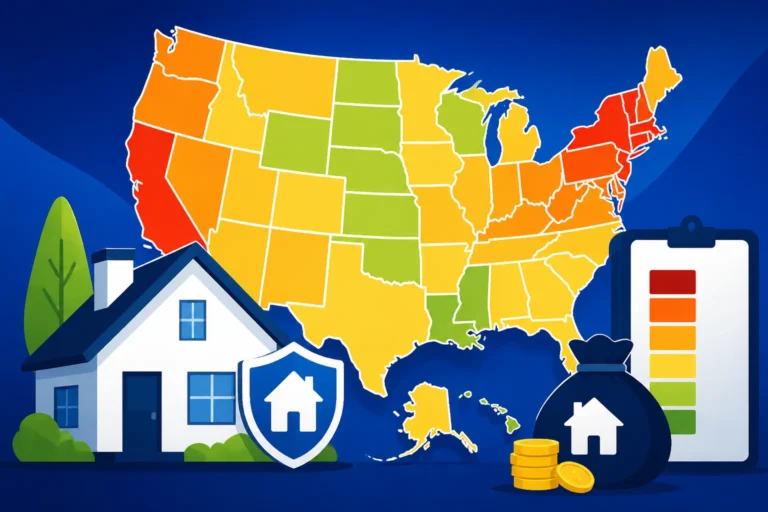
The "how" of property tax calculation changes drastically the moment you cross a state line. The United States is a patchwork of tax philosophies. Some states rely heavily on property taxes because they don't have an income tax, while others use property taxes as a secondary source of revenue.
The California Approach: Prop 13
California is famous for Proposition 13, which fundamentally changed how taxes are calculated in the Golden State. In California, your property tax is generally limited to 1% of the purchase price, plus small voter-approved bonds. More importantly, the assessed value can only increase by a maximum of 2% per year as long as you own the home.
This creates a "lock-in" effect. If you bought a home in Santa Monica in 1975, you might be paying taxes based on a valuation of $100,000, even if the home is worth $4 million today. The moment you sell that house, the new buyer’s taxes will be based on the $4 million sales price. This "acquisition value" system is very different from the "market value" system used in most other states. You can learn more about this in California Prop 13 Explained (2% Cap).
Texas and the Lack of Income Tax
Texas is the polar opposite of California in many ways. Because Texas has no state income tax, local governments rely heavily on property taxes to fund schools and infrastructure. In the Lone Star State, assessments are done annually, and they are intended to reflect 100% of the market value. While there is a 10% cap on increases for homesteaded properties, the rates themselves (the millage) tend to be much higher than in other parts of the country.
If you live in a high-growth area like Austin or Dallas, you might see a tax rate of 2.5% or even 3% of your home's value. On a $500,000 home, that’s $15,000 a year. Texas also has a unique "Appraisal Review Board" process that allows homeowners to protest their values every single spring. For those living there, understanding Texas Homestead 10% Cap Explained is the only way to keep those high rates from spiraling out of control.
The High-Tax Reality of the Northeast
The Northeast—specifically New Jersey, New York, and Connecticut—consistently tops the list for the Highest Property Taxes in the US (States, Counties, Cities). The calculation here is often driven by a high density of small, independent school districts and municipal governments. In New Jersey, for example, the "effective" tax rate is often high because there is very little "buffer" or assessment ratio—you are often taxed on nearly the full value of the home at a high rate.
The math in the Northeast is also heavily influenced by "Equalization Tables." Since each town does its own assessments, the state has to step in to make sure one town isn't artificially undervaluing its homes to pay less into the county-wide budget. This adds a layer of "state-level math" to your local bill that can be very difficult for the average homeowner to track without professional help.
Common Triggers for a Tax Increase
Most people are fine with their property taxes until they suddenly jump by 20% in a single year. When this happens, it’s usually triggered by one of three specific events. Understanding these triggers can help you plan your finances or, in some cases, avoid a surprise bill altogether.
Recent Home Renovations and Permits
If you pull a permit for a major project—adding a bedroom, installing an in-ground pool, or building a detached garage—the building department will notify the assessor. In the eyes of the tax office, you have just increased the "utility" and "desirability" of your property. For example, adding a bathroom in a suburb like Arlington, Virginia, could easily add $20,000 to $30,000 to your assessed value.
Interestingly, not all renovations trigger an increase. Routine maintenance, like putting on a new roof or replacing old windows with energy-efficient ones, usually doesn't increase your assessment. These are considered "keeping the property in its current state." However, "luxury" upgrades or square footage additions are almost guaranteed to move the needle. If you're planning a project, it's worth reading Does Renovating Increase Property Taxes? to see which projects have the highest "tax ROI."
The Impact of Neighborhood Gentrification
Sometimes, you don't have to do anything to your house for your taxes to go up. If a new high-end grocery store opens nearby, or if a tech company moves its headquarters to your town, the "market demand" for your neighborhood increases. As homes around you sell for higher and higher prices, the mass appraisal models used by the assessor will drag your value up with them.
This is a double-edged sword. On one hand, your net worth is increasing because your home is worth more. On the other hand, your monthly "holding cost" (your taxes) is rising. This is especially difficult for people on fixed incomes, such as retirees. It is the primary reason many states have implemented "senior freezes" to protect long-term residents from being "taxed out" of their own homes by neighborhood success.
Periodic Reassessment Cycles
Every state has a law dictating how often properties must be reassessed. Some places, like Florida and Texas, do it every year. Others, like parts of Pennsylvania or New York, might go a decade or more without a "reval." When a county finally does a "statistical revaluation" after many years of stagnation, the results can be shocking.
If your town hasn't reassessed in ten years and home prices have doubled in that time, your bill won't necessarily double (remember, the tax rate usually drops when values go up to keep the budget neutral), but the distribution of the tax burden will shift. If your neighborhood grew faster than the rest of the town, you will end up paying a larger percentage of the total budget than you did before. This "redistribution" is the most common cause of massive, one-year tax spikes.
What to Do When the Math Feels Wrong
The dirty secret of property tax calculation is that the government is often wrong. Because they rely on mass data and automated models, they frequently miss individual details that lower a home’s value. If you believe your calculation is incorrect, you have the legal right to challenge it, but you have to act quickly.
Gathering Evidence for an Appeal
You cannot appeal your taxes simply because you think they are "too high." You must prove that the assessor’s math is factually incorrect. This usually means proving one of two things:
- Incorrect Data: The assessor thinks you have four bedrooms when you only have three, or they have your square footage wrong.
- Unequal Appraisal: Similar homes in your neighborhood are valued lower than yours for no clear reason.
The best evidence is a list of "comparable sales" (comps). Look for homes that have sold in the last six months that are similar to yours in age, size, and condition. If the assessor says your home is worth $400,000, but three identical homes on your street sold for $370,000, you have a very strong case. For a step-by-step walkthrough on building this "evidence locker," check out How to Appeal Property Taxes: Complete Guide.
The Informal and Formal Hearing Process
Most counties offer an "informal" window where you can simply call or visit the assessor’s office. Often, if you show them a glaring error (like a photo of the cracked foundation they didn't know about), they will adjust the value on the spot. This is the easiest and cheapest way to lower your bill.
If the informal process fails, you move to a formal hearing before an Appraisal Review Board (ARB) or a Board of Equalization. This is a semi-judicial process where you present your evidence to a panel of citizens or experts. It can be intimidating, but it is a fundamental right of property ownership. Many homeowners find that even a small reduction in value pays for itself within a year or two.
Hiring Professional Help
In some high-tax states, a whole industry has sprung up to help homeowners fight their property taxes. These "tax consultants" or "tax protest companies" usually work on a contingency basis—they only get paid if they successfully lower your bill. Typically, they take 30% to 50% of the first year’s savings.
For a homeowner in a place like Westchester County, New York, or Cook County, Illinois, hiring a professional can be a smart move. These experts have access to proprietary databases and know the specific "arguments" that local boards find persuasive. However, for a simple data error, you can often save more money by doing it yourself and keeping 100% of the tax savings.
Property Tax Calculation Disclaimer
This guide is intended for informational purposes only and does not constitute legal, financial, or tax advice. Property tax laws, assessment ratios, and exemption eligibility vary significantly by state, county, and local jurisdiction. Tax rates and millage are subject to change annually based on local government budgets and voter-approved referendums. Always consult with your local county assessor's office or a qualified tax professional to confirm the specific rules and deadlines applicable to your property. Historical tax data or neighborhood comparisons do not guarantee future tax assessments. Final property tax obligations are determined solely by the official taxing authorities in your specific area.