Effective vs Nominal Property Tax Rate Explained
Most homeowners experience a specific type of sticker shock every year: you open your tax assessment, see a tax rate that looks relatively low, and then realize the actual dollar amount you owe is enough to make your eyes water. This disconnect happens because the "official" rate you hear discussed at town hall meetings rarely reflects what you actually pay out of pocket. This guide solves the mystery of the gap between these two numbers, explaining exactly how to calculate your real tax burden so you never feel blindsided by your bill again.
Understanding the Basics: Nominal vs. Effective Rates
When you first start looking at property taxes, the terminology can feel like a foreign language designed to keep you in the dark. I have spent years talking to homeowners who felt like they were failing a math test every time they looked at their escrow statements. The first step to regaining control is understanding that there are two different ways to measure your tax rate, and they serve very different purposes. One is used by the government to set budgets, while the other is used by you to understand your actual cost of living.
Defining the Nominal Property Tax Rate
The nominal property tax rate is the "official" rate established by your local taxing authorities. If you attend a city council meeting or a school board hearing, this is the number they are debating. It is the raw percentage or millage rate applied to the taxable value of your home. However, the nominal rate is often a "paper" number. It doesn't account for the fact that your home might only be assessed at a fraction of what it is actually worth on the open market. Because of this, the nominal rate can be incredibly misleading. You might live in a town with a 4% nominal rate, which sounds terrifying, until you realize they only assess homes at 25% of their value.
To get a true sense of how these numbers are generated, you should look into How Are Property Taxes Calculated? to see the math behind the curtain. The nominal rate is essentially a tool for the government. They know how much money they need to run the schools, pave the roads, and pay for police services. They look at the total "assessed value" of the entire town and then set a nominal rate that will generate the necessary revenue. It is the starting point of the calculation, but for the individual homeowner, it is rarely the final word on what leaves your bank account.
Defining the Effective Property Tax Rate
The effective property tax rate is the "truth-teller" in the world of real estate. This is the rate you actually pay based on the current market value of your home. To find this number, you take the total amount of property tax you paid for the year and divide it by what your home would realistically sell for today. For example, if your home is worth $500,000 and you paid $5,000 in taxes, your effective property tax rate is exactly 1%. It doesn't matter what the "mill rate" or the "assessment ratio" was; that 1% represents your actual tax burden.
I always tell people who are moving across state lines to ignore nominal rates and look strictly at effective rates. If you are moving from a state with high home values but low nominal rates to a state with low home values but high nominal rates, you might find that your actual tax bill remains the same. The effective rate levels the playing field, allowing you to compare a bungalow in Florida with a condo in New Jersey. It is the most honest metric we have for determining which areas are truly "high tax" and which are "low tax." For a broader perspective on how these rates shift across the country, you can check out the Property Tax by State 2026: All 50 States Ranked list.
Why the Distinction Matters for Homeowners
Why should you care about the difference? Because understanding the gap between nominal and effective rates is the only way to know if you are being overcharged. If your effective rate is significantly higher than the average for your neighborhood, it is a massive red flag that your home might be over-assessed. On the flip side, if you are planning a renovation or looking to buy a new property, using the nominal rate to estimate your future taxes will almost always lead to an incorrect—and usually lower—estimate than reality.
I’ve seen families move into a "low tax" district only to find their effective rate was sky-high because the local assessment office had just completed a town-wide reassessment. By focusing on the effective rate, you are looking at the actual economic impact on your household budget. It allows you to plan for the future with clarity. If you're curious about how your local government arrived at their specific numbers, reading about Who Sets Property Tax Rates? (County, School, City Levies can give you a better understanding of the political and budgetary pressures that drive these rates up or down every year.
How Nominal Rates Are Calculated and Set
The process of setting a nominal tax rate is part accounting and part politics. Every year, local governments go through a "budgeting" phase where they determine their expenses for the upcoming fiscal year. This includes everything from the salaries of public employees to the cost of salt for the roads in winter. Once they have a total dollar amount, they look at the "tax base"—which is the total value of all taxable property in the jurisdiction—and do the math to figure out what percentage they need to charge to cover those costs.
The Role of Taxing Authorities
It is a common misconception that there is just one "tax man" who sends you a bill. In reality, your property tax bill is a collection of levies from several different taxing authorities. Usually, this includes your county government, your city or municipal government, and your local school district. In many areas, there are also "special districts" for things like water management, parks, libraries, or even mosquito control. Each of these entities sets its own nominal rate.
When you look at your annual statement, you are seeing the "aggregate" nominal rate, which is the sum of all these individual pieces. I recommend that every homeowner learn How to Read Your Property Tax Bill because it allows you to see exactly where your money is going. You might find that while your city taxes are low, your school district taxes are enormous. This is often where the real political battles happen, as residents vote on school bonds or library levies that directly increase the nominal rate.
Understanding Mill Rates and Levies
In many parts of the United States, the nominal rate isn't expressed as a percentage, but as a "mill rate." This is one of the most confusing parts of property tax for the average person. A "mill" represents one-tenth of one cent, or $1 of tax for every $1,000 of assessed value. So, if your town has a mill rate of 20, you pay $20 for every $1,000 of your home's assessed value.
The math isn't hard once you get used to it, but it’s designed in a way that makes the numbers sound smaller than they are. Saying "we are increasing the rate by 2 mills" sounds much more palatable to voters than saying "we are increasing your tax bill by $400." To dive deeper into this specific unit of measurement, you should definitely read What Is a Mill Rate? (Millage Explained. Understanding millage is the key to unlocking the secrets of your tax bill and participating effectively in local budget hearings.
How Budgetary Needs Influence the Nominal Rate
The nominal rate is incredibly sensitive to the local economy. If a major employer leaves a town, the "tax base" shrinks. However, the town's expenses—like maintaining the roads that lead to that empty factory—often stay the same. To make up for the lost revenue, the taxing authorities have to raise the nominal rate on the remaining homeowners. This is why you often see high nominal rates in economically depressed areas; the government is trying to squeeze the same amount of revenue out of a smaller pool of value.
Conversely, in booming areas where property values are skyrocketing, you might see the nominal rate actually go down. If everyone's home value doubles, the city doesn't necessarily need twice as much money to operate. They can lower the nominal rate and still collect enough revenue to meet their budget. This is a crucial point: a falling nominal rate does not always mean your taxes are going down. If your home's value is rising faster than the rate is falling, your bill will still increase. This phenomenon is a core reason Why Do Property Taxes Increase? even when politicians claim they are "cutting" rates.
The Mechanics Behind the Effective Property Tax Rate
The effective property tax rate is where the rubber meets the road. It bypasses all the bureaucratic jargon and looks at the actual financial burden on the property owner. To understand why your effective rate is what it is, you have to look at the relationship between your home's market value and how the government chooses to "assess" that value.
The Impact of Assessment Ratios
The biggest reason for the massive gap between nominal and effective rates is the "assessment ratio." Most states do not tax 100% of your home's market value. Instead, they use a legal formula to determine what portion of that value is actually taxable. For example, in some states, the law might dictate that residential property is assessed at only 10% of its market value.
Imagine a home worth $400,000 in a state with a 10% assessment ratio. The "assessed value" would only be $40,000. If the nominal tax rate is a whopping 10%, the tax bill would be $4,000. On paper, a 10% tax rate sounds like highway robbery. But in reality, $4,000 on a $400,000 home is an effective rate of only 1%. This is why the nominal rate is often meaningless without context. You can learn more about how these ratios are applied in the Property Tax Assessment & Reassessment Explained guide, which breaks down how different states handle these percentages.
Market Value vs. Assessed Value
The battle between market value and assessed value is a constant source of frustration for homeowners. Market value is what a willing buyer would pay you for your house today. Assessed value is the number the local tax assessor has on file for your property. In a perfect world, these two numbers would be the same, but we don't live in a perfect world. Assessors are often overworked and use "mass appraisal" techniques that don't account for the specific condition of your home.
Furthermore, many jurisdictions only reassess properties every few years. If you live in an area where prices are rising 10% a year, but the last reassessment was five years ago, your assessed value is significantly lower than your market value. This "lag" is a major driver of low effective rates. However, when the reassessment finally happens, it can lead to a massive spike in your bill. Understanding the nuance between Assessed Value vs Market Value vs Taxable Value is essential for any homeowner who wants to ensure they aren't paying more than their fair share.
Calculating Your Own Effective Rate
I recommend that every homeowner calculates their effective rate at least once a year. It’s a simple three-step process. First, find your total property tax bill for the year (make sure to include all city, county, and school taxes). Second, get a realistic estimate of your home's current market value—you can use recent sales of similar homes in your neighborhood or a professional appraisal. Third, divide the tax amount by the market value.
| Scenario | Market Value | Total Annual Tax | Effective Rate |
|---|---|---|---|
| New Jersey Home | $500,000 | $12,500 | 2.5% |
| Texas Home | $350,000 | $6,300 | 1.8% |
| California Home | $800,000 | $8,800 | 1.1% |
| Arizona Home | $450,000 | $2,700 | 0.6% |
This table shows how vastly different the effective rates can be across the country. If you find your effective rate is drifting higher than 2% or 3%, you are likely in a high-tax jurisdiction or your home is over-assessed. If you're looking to move and want to find the most tax-friendly areas, check out Lowest Property Tax States 2027 to see where you might get the most house for your money.
Why Your Tax Bill Doesn't Match the Nominal Rate
Even after you account for the assessment ratio, you might find that your bill still doesn't quite add up. This is because there are "invisible" layers of protection or complication built into the tax code. From exemptions that shave value off the top to caps that prevent your taxes from rising too fast, these factors further widen the gap between the nominal rate and what you actually pay.
Exemptions and Abatements
Exemptions are the best friend of the homeowner. The most common is the "Homestead Exemption," which is a legal provision that allows you to shield a portion of your primary residence's value from taxation. For instance, if your home is worth $300,000 and you have a $50,000 homestead exemption, you are only taxed as if the home were worth $250,000. This immediately lowers your effective rate compared to the nominal rate.
There are also specific exemptions for seniors, veterans, and people with disabilities. In some cases, these can be so significant that they virtually eliminate the property tax bill altogether. I always tell my readers to check with their local assessor’s office to make sure they are claiming every possible credit. You can find a comprehensive list of these opportunities in the Homestead Exemption: Complete State-by-State Guide. If you aren't using these, you are essentially leaving money on the table.
Phase-ins and Assessment Caps
In some states, the government has recognized that skyrocketing home values can price long-time residents out of their homes. To combat this, they have implemented "assessment caps." These laws limit how much your assessed value can increase in a single year, regardless of how much the market value has gone up.
California is the most famous example of this. Under Prop 13, a home's assessed value can generally only increase by a maximum of 2% per year as long as the owner doesn't sell. If you bought a home in San Francisco in the 1970s, your "assessed value" might be $100,000 while the "market value" is $2 million. In this scenario, your effective property tax rate would be incredibly low—a tiny fraction of 1%. You can read the full breakdown of this in California Prop 13 Explained (2% Cap. These caps create a massive disparity between what new buyers pay and what long-term owners pay, further complicating the nominal vs. effective rate comparison.
The Surprise of Supplemental Tax Bills
One of the most painful surprises for new homeowners is the supplemental tax bill. When you buy a house, the tax office often continues to bill you based on the previous owner's assessed value for the first few months. Eventually, they realize the home was sold for a much higher price and they issue a "catch-up" bill to cover the difference.
This happens most frequently in states like California, where the gap between old and new assessments is huge. If you aren't prepared for it, a supplemental bill can ruin your first year of homeownership. I highly recommend learning about the Supplemental Property Tax Bill Explained (California so you can set aside the cash you'll eventually need. This is another example of why the nominal rate you see on a listing might not be what you actually pay once the deed is in your name.
Comparing Tax Burdens Across Different Regions
When you're looking at property taxes from a national perspective, the nominal rate is almost entirely useless. To truly understand where the tax burden is heaviest, you have to look at the effective rate in the context of other local taxes. Some states have no income tax but very high property taxes, while others have low property taxes but high sales and income taxes.
National Averages and Regional Disparities
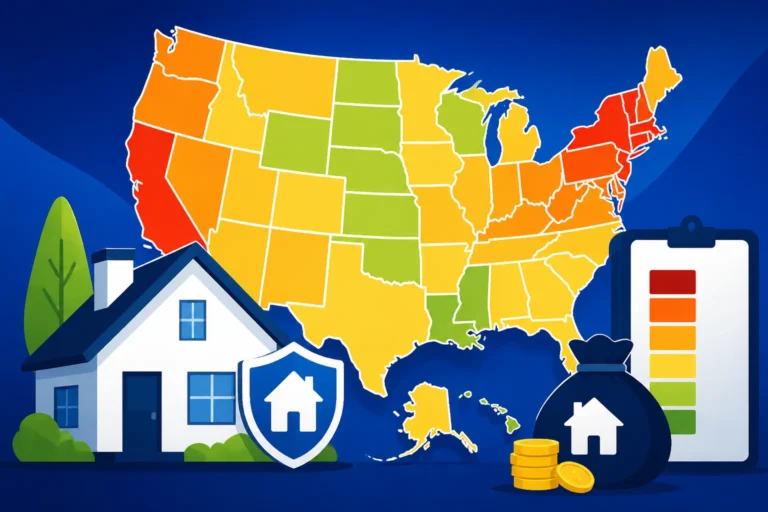
The average effective property tax rate in the United States is roughly 1.1%, but that number hides a massive amount of regional variation. In the Northeast and parts of the Midwest, effective rates frequently climb above 2%. In Hawaii and parts of the South, they can drop below 0.5%. These differences are often driven by how local services are funded.
In states like New Jersey, which consistently ranks near the top of the Highest Property Taxes in the US (States, Counties, Cities list, property taxes fund the vast majority of school and municipal costs. In other states, the state government provides more funding from income or sales tax, allowing property tax rates to remain lower. When you are comparing regions, you have to look at the "total tax burden," not just one piece of the puzzle.
Why Some Low-Rate States Actually Cost More
There is a common trap that buyers fall into: chasing a low nominal rate into a high-cost area. Let's look at Texas vs. California. Texas has a much higher nominal and effective property tax rate than California. However, Texas has no state income tax. California has a lower effective property tax rate (thanks to Prop 13), but some of the highest income tax rates in the country.
I’ve had friends move to "low property tax" states only to find that their overall cost of living increased because they were suddenly paying for private garbage pickup, higher car registration fees, and steep sales taxes. The "effective rate" of a property tax is just one line item on your household balance sheet. You have to look at the whole picture to know if you're actually saving money. For those looking for the absolute basement prices on taxes, the Lowest Property Tax States 2027 guide is a great place to start your research.
How to Compare "Apples to Apples"
The best way to compare two different locations is to use a hypothetical $500,000 home. Don't look at what the "average" person pays, because home values vary so much. Instead, ask: "If I bought a $500,000 house in City A and a $500,000 house in City B, what would my check to the tax collector be each year?"
This "apples to apples" comparison bypasses the confusion of nominal rates and assessment ratios. It tells you exactly what the cost of entry is for that community. If City A has a 2% effective rate and City B has a 1% effective rate, you are paying $5,000 more per year to live in City A. Over a 30-year mortgage, that is $150,000—a massive difference that could be used for retirement, travel, or your children's education.
Practical Steps for Homeowners and Buyers
If you are currently in the market for a home, or if you already own one and feel like your taxes are spiraling out of control, there are concrete steps you can take to manage your effective rate. You don't have to just sit back and accept whatever number the county sends you in the mail.
Estimating Taxes Before You Buy
One of the biggest mistakes buyers make is trusting the tax amount listed on Zillow or Redfin. Those numbers are often based on the current owner's tax bill, which might be artificially low due to an old assessment or a senior exemption that won't apply to you. When you buy a house, the sale price often triggers a "reassessment" that brings the tax bill up to current market levels.
To avoid a nightmare scenario where your mortgage payment jumps by $400 a month after your first year, you need to do your own math. Take the purchase price and multiply it by the local effective tax rate. If you aren't sure what the rate is, a Property Tax Calculator: How to Estimate Your Bill can be an invaluable tool. It allows you to enter your specific location and purchase price to get a much more realistic estimate of your future obligations.
How to Read Your Annual Tax Statement
When your tax bill arrives, don't just look at the "Amount Due" and write a check. Take ten minutes to read the fine print. Look for your "Market Value" and your "Assessed Value." If the "Market Value" listed by the tax office is higher than what you could actually sell the house for, you are being overcharged. Your effective rate is higher than it should be because the base of the calculation is wrong.
Look at the individual taxing entities listed on the bill. Sometimes, a "special assessment" for a new sewer line or a neighborhood improvement district will be added to your bill for a set number of years. If you don't know why your bill went up, these individual line items usually hold the answer. I’ve seen cases where people were still paying "temporary" levies that should have expired years ago. Being a proactive reader of your bill is the first step toward lowering it.
Identifying Potential Errors in Assessment
Assessed values are not set in stone. Because assessors deal with thousands of properties, they often make mistakes. They might think your house has 3,000 square feet when it only has 2,500. They might think you have a finished basement when it's actually just concrete and spiders. Any error that inflates your assessed value also inflates your effective tax rate.
If you find an error, you have the right to protest your assessment. This is a formal process where you present evidence—like photos of your unfinished basement or a recent appraisal—to the county board. Many homeowners are intimidated by this, but it is often the only way to bring your effective rate back in line with the rest of the neighborhood. Understanding Property Tax Assessment & Reassessment Explained will give you the confidence to challenge the status quo and potentially save thousands of dollars over the life of your homeownership.
Strategic Planning for Long-Term Property Ownership
Property taxes aren't a static expense; they are a dynamic part of your financial life that will change as you age and as your home changes. Long-term planning means looking beyond this year's bill and thinking about how your effective rate will evolve over the next decade or two.
Forecasting Future Tax Increases
In most parts of the country, property taxes trend in one direction: up. Even if the nominal rate stays the same, as your home value increases, your bill will follow. When you are planning your long-term budget—especially if you are on a fixed income—you need to build in a "buffer" for tax increases.
I usually recommend assuming a 3% to 5% increase in your tax bill every year. If you live in an area with assessment caps, your increase might be lower, but it’s always better to be pleasantly surprised by a lower bill than devastated by a higher one. Keeping an eye on local Property Tax Trends 2026 can help you see which way the wind is blowing in your specific region.
The Effect of Home Renovations
One of the quickest ways to spike your effective tax rate is to pull a building permit. When you add a bedroom, finish a basement, or build a massive deck, the building department notifies the tax assessor. They will then "revalue" your home to account for these improvements.
While renovations increase your home's market value (which is good), they also increase your assessed value (which means higher taxes). Before you start a major project, it’s worth calling the assessor’s office to ask how much a similar project usually adds to a property’s taxable value. You might find that the "dream kitchen" comes with a side of $1,000 in extra taxes every single year.
Planning for Retirement on a Fixed Income
For many seniors, property tax is the single biggest threat to their ability to stay in their homes. If you bought a home for $100,000 thirty years ago and it’s now worth $1 million, your tax bill might have grown from $1,500 to $15,000. If your income hasn't grown at the same rate, that $1,250 a month for taxes can be crushing.
This is why understanding exemptions and "tax freezes" for seniors is so vital. Many states offer programs that allow seniors to "freeze" their property tax bill at its current level once they reach a certain age, or they offer "circuit breaker" credits that limit taxes to a certain percentage of their income. Planning for these protections well before you retire is a key part of financial literacy. If you’re worried about this, exploring the Homestead Exemption: Complete State-by-State Guide is a great first step toward securing your future.
Property Tax Disclosure
Property tax laws, nominal rates, and assessment ratios are subject to frequent change by local and state legislative bodies. The information provided in this guide is for educational and informational purposes only and does not constitute legal, financial, or tax advice. Homeowners should always verify current rates and exemption eligibility with their local county assessor or a qualified tax professional to ensure accuracy for their specific property and jurisdiction.