Property Tax Assessment Ratio by State
Most homeowners open their annual tax assessment notice and feel a wave of confusion. You see your home is valued at a fraction of what you know it could sell for on the open market, or perhaps the numbers seem entirely disconnected from reality. This guide breaks down the property tax assessment ratio, explaining why states use these specific percentages and how they ultimately determine what you owe.
Understanding the Property Tax Assessment Ratio
If you have ever looked at your tax bill and wondered why the county thinks your $500,000 home is only "worth" $150,000 for tax purposes, you have encountered the assessment ratio. It is one of those dense, technical terms that tax assessors use, but for the average person, it feels like a riddle wrapped in a mystery. Simply put, an assessment ratio is the percentage of a property’s fair market value that is taxed.
While it might seem like the government is giving you a break by valuing your home lower than its actual price, the ratio is really just a mathematical tool used to level the playing field across different types of properties and jurisdictions. Understanding this ratio is the first step in figuring out if your bill is fair or if you are being overcharged compared to your neighbors.
What Exactly is an Assessment Ratio?
Think of the assessment ratio as a bridge. On one side of the bridge, you have the "Market Value"—what a willing buyer would pay you for your home today. On the other side, you have the "Assessed Value," which is the dollar amount the local government uses to apply tax rates. The assessment ratio is the percentage that gets you from one side to the other. For example, if your state has a 25% assessment ratio, a home with a market value of $400,000 would have an assessed value of $100,000.
In a perfect world, every property would be taxed at 100% of its value, making the math easy. However, many states use fractional assessments to manage the "taxable base" without having to constantly fluctuate tax rates as the real estate market booms or busts. This creates a buffer, but it also creates confusion. When you look at your bill, you need to know which percentage your county is using, or you might mistakenly think your home is being undervalued.
The Difference Between Assessed Value and Market Value
One of the most frequent frustrations I hear from homeowners is the disconnect between their tax bill and their Zillow estimate. It is vital to understand that Assessed Value vs Market Value vs Taxable Value are three very different numbers. Market value is a moving target based on supply, demand, and comparable sales in your neighborhood. Assessed value is a snapshot in time, often lagging behind the market by a year or more, and modified by that assessment ratio we just discussed.
To complicate things further, some states apply "caps" on how much that assessed value can grow each year. This means that even if the market value of your home skyrocketed by 20% in a single year, your assessed value might only be allowed to rise by 3%. This is why long-term homeowners often pay significantly less in taxes than someone who just bought the identical house next door. This is a common feature in states with Property Tax Assessment & Reassessment Explained guidelines that favor stability over immediate market accuracy.
Why States Use Fractions Instead of Full Value
You might wonder why a state would bother with a 4% or 10% ratio instead of just using 100%. Historically, fractional assessment ratios were used to hide high tax rates or to make property tax increases feel less burdensome. If a local government wants to raise $1,000 in revenue, it looks "better" to have a high tax rate on a low assessed value than a moderate tax rate on a full market value. It is a bit of a psychological game played with public finances.
Additionally, fractional ratios allow states to treat different types of property differently without changing the base tax rate. For instance, a state might decide that residential homes should only be assessed at 10% of their value to keep housing affordable, while commercial strip malls are assessed at 25% because they generate income. By adjusting the ratio rather than the millage rate, the legislature can target specific sectors of the economy for relief or higher contributions.
How Assessment Ratios Impact Your Tax Bill
It is a common misconception that a lower assessment ratio automatically leads to a lower tax bill. In reality, the ratio is only half of the equation. Local governments determine how much money they need for schools, roads, and emergency services, and then they adjust the "mill rate" to ensure they collect that amount. If the assessment ratio is low, the mill rate is usually high. If the ratio is high, the mill rate is often lower.
When you receive your tax notice, you shouldn't just look at the assessed value in a vacuum. You have to see how that value interacts with the local levies. This is why two people in different states with the exact same home value can end up with wildly different bills. The interplay between the ratio and the rate is where the "real" cost of homeownership is hidden.
The Formula: From Market Value to Final Tax
To truly understand your bill, you have to do a little bit of manual math. The standard process follows a very specific path. First, the assessor determines your market value. Then, they multiply that by the state or county’s assessment ratio to get your assessed value. From there, any exemptions (like a homestead exemption) are subtracted to find your "taxable value." Finally, that taxable value is multiplied by the mill rate.
Here is a quick breakdown of How Are Property Taxes Calculated? using this logic:
- Market Value: $300,000
- Assessment Ratio (e.g., 10%): $300,000 x 0.10 = $30,000 (Assessed Value)
- Exemptions: $30,000 – $5,000 = $25,000 (Taxable Value)
- Mill Rate (e.g., 80 mills or 8%): $25,000 x 0.08 = $2,000 (Total Tax)
If the ratio were 100%, the mill rate would likely be much lower—perhaps 6.6 mills (0.66%)—to arrive at that same $2,000 total. The ratio is simply a lever that changes the scale of the numbers.
Mill Rates and Their Relationship with Assessment Ratios
The term "millage" or "mill rate" often scares people off, but it is just a way of saying "tax per thousand dollars of value." If you are curious about the deeper mechanics, you should check out What Is a Mill Rate? (Millage Explained) to see how these numbers are set by school boards and county commissions. The important thing to remember is the inverse relationship: a lower assessment ratio usually necessitates a higher mill rate.
In states with very low assessment ratios, like South Carolina where the residential ratio is only 4%, the mill rates look astronomical—sometimes 300 or 400 mills. Conversely, in a state like Florida where the ratio is 100%, the mill rates might be a modest 15 or 20. Don't let the high mill rate in a low-ratio state trick you into thinking you are being overtaxed; always look at the final dollar amount relative to your home's actual value.
Avoiding the Sticker Shock of Reassessments
One of the most stressful moments for a homeowner is the year of a "general reassessment." This is when the county updates its records to reflect current market values. If your market value has doubled since the last check, your assessed value will likely follow suit, even if the assessment ratio stays the same. This can lead to a massive jump in your escrow payment, often referred to as "sticker shock."
However, many states have laws that require local governments to lower their mill rates when property values rise significantly. This is called a "revenue neutral" rate. The goal is to prevent the government from getting a massive windfall just because the housing market is hot. Understanding How Often Is Property Reassessed? in your specific area can help you plan for these jumps and ensure you aren't caught off guard by a bill that doubles overnight.
State-by-State Assessment Ratio Comparison 2026
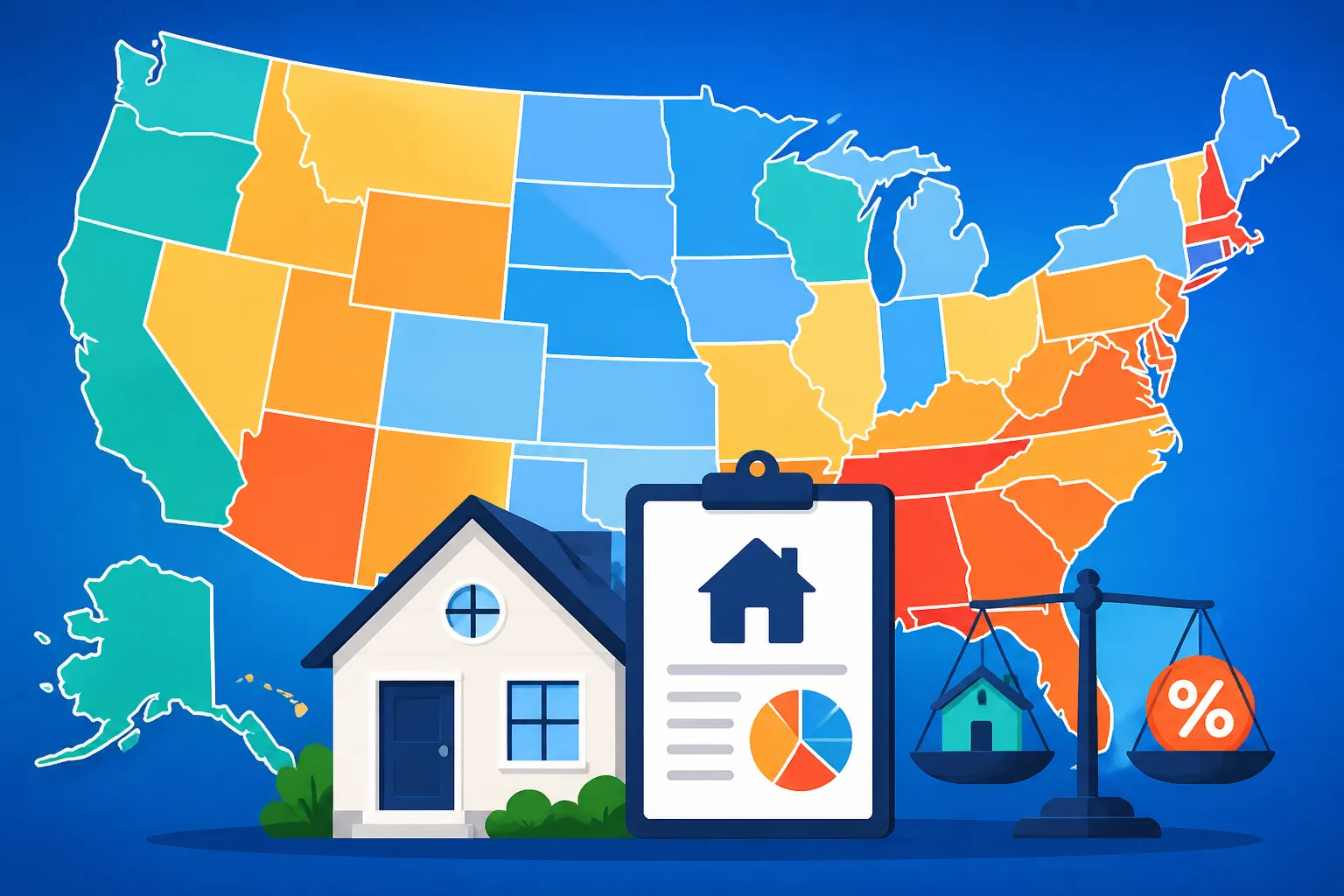
Property tax laws are notoriously local, and every state has its own philosophy on how to value land and buildings. Some states are "Market Value States," meaning they aim for a 100% assessment ratio. Others are "Fractional States," where the ratio might be as low as a few percentage points. Below is a look at how different regions handle these calculations.
| State | Residential Assessment Ratio | Commercial Assessment Ratio | Notes |
|---|---|---|---|
| Alabama | 10% | 20% | Very low residential ratio; favors homeowners. |
| Arizona | 10% | 16% | Ratios are set by the legislature and frequently debated. |
| California | 100% | 100% | Guided by California Prop 13 Explained (2% Cap). |
| Colorado | ~6.7% | 29% | Residential ratio fluctuates based on state-wide balances. |
| Florida | 100% | 100% | Assessment growth is capped at 3% for primary residences. |
| Georgia | 40% | 40% | Uniform across most property classes. |
| Illinois | 33.33% | 33.33% | Cook County uses a different, more complex system. |
| Nevada | 35% | 35% | Used in conjunction with high depreciation factors. |
| New York | Varies | Varies | Highly complex; depends on "Assessing Units." |
| S. Carolina | 4% | 6% | One of the lowest residential ratios in the country. |
States with 100% Assessment Ratios
In states like Florida, California, and many throughout the Northeast, the goal is transparency. They use a 100% assessment ratio, meaning your assessed value should, in theory, match what you could sell the house for. This makes it much easier for a homeowner to spot an error. If the county says your house is worth $600,000 but you know it’s only worth $500,000, the 100% ratio makes that $100,000 discrepancy obvious.
However, even in these 100% states, the "Taxable Value" is rarely the full market value. Protections like What Is a Homestead Assessed Value Cap? ensure that even if the ratio is 100%, the value used for taxes doesn't skyrocket. These caps are the real heroes for long-term residents, as they disconnect the tax bill from the volatile real estate market.
States with Fractional Assessment Ratios
Fractional states like Georgia (40%) or Alabama (10%) require a bit more mental gymnastics. In these areas, you have to be careful when comparing your taxes to someone in another state. A "1% tax rate" in Alabama is much cheaper than a "1% tax rate" in Florida because the Alabama rate is only applied to 10% of the home's value.
When living in a fractional state, it is helpful to look at the Effective vs Nominal Property Tax Rate Explained to get the true picture. The "nominal" rate is what is printed on the bill (e.g., 50 mills), but the "effective" rate is the percentage of your home's total value that you actually pay in cash. Usually, fractional states end up with effective rates between 0.5% and 1.5%, which is right in line with the national average.
Hybrid and Local-Option Systems
Then there are the "wild card" states. New York is a prime example where assessment ratios are not uniform across the state. Each town or city can choose its own "Level of Assessment." One town might assess at 100%, while the neighboring town assesses at 15%. This makes state-wide comparisons nearly impossible without looking at the equalization rate—a number the state uses to try and make sense of the local chaos.
Illinois also has a unique system, specifically in Cook County (Chicago). While the rest of the state generally sticks to a one-third (33.33%) ratio, Cook County uses different percentages for different types of property. This complexity often leads to more frequent appeals and a greater need for professional tax consultants.
Why Assessment Ratios Vary by Property Type
One of the biggest "gotchas" in the world of property tax is that not all buildings are created equal in the eyes of the law. If you own a house, you likely benefit from a lower assessment ratio than the person who owns the office building downtown. This is a deliberate policy choice by state governments to shift the tax burden away from individual residents and onto businesses or "income-producing" properties.
This disparity is one of the main reasons why commercial real estate investors are so aggressive about protesting their values. When your ratio is two or three times higher than a residential ratio, a small mistake by the assessor can result in tens of thousands of dollars in extra taxes.
Residential vs. Commercial Disparities
In many states, the gap between residential and commercial ratios is significant. In South Carolina, for instance, an owner-occupied home is assessed at 4%, while a commercial building is assessed at 6%. That 2% difference might seem small, but it represents a 50% higher tax base for the business owner. In Arizona, the gap is even wider, with residential at 10% and most commercial properties at 16%.
This creates a "tax tilt" where homeowners are essentially subsidized by the local business community. While this is great for your personal budget, it can sometimes lead to tension during local elections when business owners push for commercial tax reform. It also means that if you decide to turn your primary residence into a full-time rental property, you might "trigger" a change to a higher assessment ratio, causing your tax bill to jump.
Agricultural Land and Special Classifications
Farmers and owners of large tracts of undeveloped land often get the best deal of all. Most states have special "Agricultural Use" or "Open Space" classifications. Instead of being taxed on what the land could sell for (e.g., as a new housing development), it is taxed based on its "Productivity Value"—what it can earn from growing corn or grazing cattle.
The assessment ratios for these properties are often the same as residential ones, but the market value they are applied to is drastically reduced. This is a vital protection for family farms that would otherwise be taxed out of existence by rising land values in suburban areas. However, these programs often come with "rollback taxes" if you decide to sell the land to a developer, requiring you to pay back the tax savings for the previous 3 to 5 years.
The Role of Homestead Exemptions in Effective Ratios
Finally, we have to talk about how exemptions interact with these ratios. A homestead exemption isn't technically a change in the ratio, but it acts like one. By knocking $25,000 or $50,000 off your assessed value, the government is essentially lowering your "effective" assessment ratio.
For example, if you have a $100,000 home in a state with a 100% ratio, but you have a $50,000 exemption, you are only being taxed on 50% of your value. This is why it is so important to check the Property Tax Rates by State: Effective Rate Map to see what people are actually paying after all the math is finished. In many cases, the state with the "scary" high tax rate actually has so many exemptions that the final bill is quite reasonable.
How to Navigate Changes in Your Assessment Ratio
While the assessment ratio itself is usually set by state law and doesn't change often, the "Assessed Value" changes every time your property is reviewed. As a homeowner, you aren't just a passive observer in this process. You have the right to double-check the assessor's math and ensure they are applying the correct ratio and market value to your specific parcel.
If you see a sudden jump in your bill, don't just grumble and pay it. Take a moment to look at the "Notice of Value" that arrives in the mail a few months before the bill. This is your window of opportunity to fix mistakes before they become permanent for the tax year.
What Triggers a Change in Your Ratio?
As mentioned, the ratio is usually stable, but certain life events can trigger a change in how your property is classified. The most common trigger is a change in use. If you move out of your home and turn it into a short-term rental (like an Airbnb), many counties will reclassify the property from "Residential" (low ratio) to "Commercial" or "Non-Primary Residential" (high ratio).
Another trigger is new construction or major renovations. While this doesn't change the percentage of the ratio, it often triggers a "spot reassessment." The county will look at your building permit and realize your home is now worth much more than it was last year. This is why many people see their taxes jump after they add a pool or finish a basement; the ratio stays the same, but the "Market Value" part of the equation is updated.
Challenging an Incorrect Assessment
If you believe the assessor has overvalued your home—and by extension, created an unfairly high assessed value—you have the right to protest. Every county has a formal appeal window, usually 30 to 90 days after the valuation notices are mailed. You will need to provide evidence, such as recent sales of similar homes in your neighborhood or a professional appraisal.
I highly recommend reading the How to Appeal Property Taxes: Complete Guide if you are considering this route. It isn't just about saying "my taxes are too high." You have to prove that the "Market Value" the county used is incorrect. If you can lower the market value, the assessment ratio will automatically work in your favor to lower the final bill.
Monitoring Local Legislative Shifts
Finally, keep an ear to the ground regarding local politics. Because property taxes are the lifeblood of local schools and cities, the rules around assessment ratios are often a hot topic at the state capitol. Legislators sometimes propose "buying down" the assessment ratio using state surplus funds to provide property tax relief.
In 2026, we are seeing several states experiment with "Assessment Caps" that prevent the taxable value from rising more than a certain percentage, regardless of what the market does. These legislative shifts can be even more impactful than a change in the tax rate itself. Being an informed homeowner means knowing not just what you owe today, but how the rules might change tomorrow.
Frequently Asked Questions About Assessment Ratios
Does a Lower Ratio Always Mean Lower Taxes?
No. As we've discussed, a low ratio often results in a higher mill rate. For example, a state with a 4% assessment ratio might have a mill rate of 300, while a state with a 100% ratio has a mill rate of 12. The final tax bill depends on the "Effective Tax Rate," which is the total tax divided by the home's market value. Always compare the total dollar amount, not just the ratio.
Can Assessment Ratios Change Annually?
Typically, the assessment ratio is set by state statute and remains the same for years. However, the Market Value is what changes annually or biennially. Some states, like Colorado, have historically used a floating residential assessment ratio that changed every two years to maintain a balance between residential and commercial tax collections, though these laws are frequently subject to voter referendums and legislative changes.
Disclaimer
Property tax laws, assessment ratios, and millage rates are subject to frequent changes by state legislatures and local taxing authorities. The information provided in this guide is for educational purposes only and may not reflect the most recent legislative updates in your specific jurisdiction for the 2026 tax year. Always consult with your local county assessor’s office or a qualified tax professional before making financial decisions based on your property tax assessment.