Property Tax Rates by State: Effective Rate Map
You finally find the perfect home, the mortgage is approved, and then you see it: the property tax bill. It is a gut-punch that many homeowners in high-cost areas like Illinois or New Jersey know all too well, often feeling like a second mortgage that never goes away. This guide breaks down the effective property tax rates by state, showing you exactly where your money goes and why these rates vary so drastically across the country.
Understanding Effective Property Tax Rates
When you start looking at tax bills, you will likely run into a lot of confusing jargon. You might hear someone talk about "millage" or "assessment ratios," but for the average person trying to budget for a home, those numbers do not mean much on their own. The real number you need to care about is the effective property tax rate. This is essentially the percentage of your home's total value that you pay in taxes every year. It is the great equalizer that allows us to compare a home in Austin, Texas, to a home in Newark, New Jersey, even though their local tax laws are worlds apart.
Nominal vs Effective Rates
The nominal rate is the number you usually see on a government website—maybe it is expressed as a percentage or a mill rate. However, that number can be incredibly misleading. For example, a town might have a high nominal tax rate, but they only assess your home at 50% of its actual market value. This is where Effective vs Nominal Property Tax Rate Explained becomes a vital concept for homeowners. The effective rate cuts through the noise by looking at what you actually pay relative to what the house is worth on the open market.
If you are living in a state where the "nominal" rate looks low, do not get too excited just yet. I have seen homeowners in certain Midwest counties get blindsided because while the rate looked like a bargain, the lack of assessment caps meant their bills skyrocketed as soon as the local housing market heated up. Understanding the effective rate is the only way to get a true "apples-to-apples" comparison when you are looking at Property Tax by State 2026: All 50 States Ranked. It prevents you from making a massive financial mistake based on incomplete data.
How the Effective Rate is Calculated
Calculating the effective rate is basically a bit of "back-of-the-napkin" math that every savvy homeowner should know. You take the total tax paid and divide it by the current market value of the property. Local governments often use a complex web of school levies, county bonds, and city fees to build your bill. When you see your final statement, it is a cumulative total of all these different taxing districts.
The reason we focus so heavily on the effective rate in this guide is that it accounts for the quirks in how different states handle valuations. Some states might reassess your home every single year, while others might only do it when the property changes hands. If you are curious about the technical side of how these numbers are generated, you should definitely look into How Are Property Taxes Calculated? to see the gears turning behind the scenes. It is rarely a simple "one-and-done" calculation; it is a living, breathing financial obligation.
Why Effective Rates Matter for Homebuyers
If you are planning a move, especially across state lines, the effective property tax rate should be one of the top three numbers on your spreadsheet, right next to the purchase price and the interest rate. I have talked to so many people who moved from California to Texas thinking they were going to save a fortune, only to realize that their property tax bill doubled. They traded a state income tax for a massive property tax bill, and the effective rate was the warning sign they ignored.
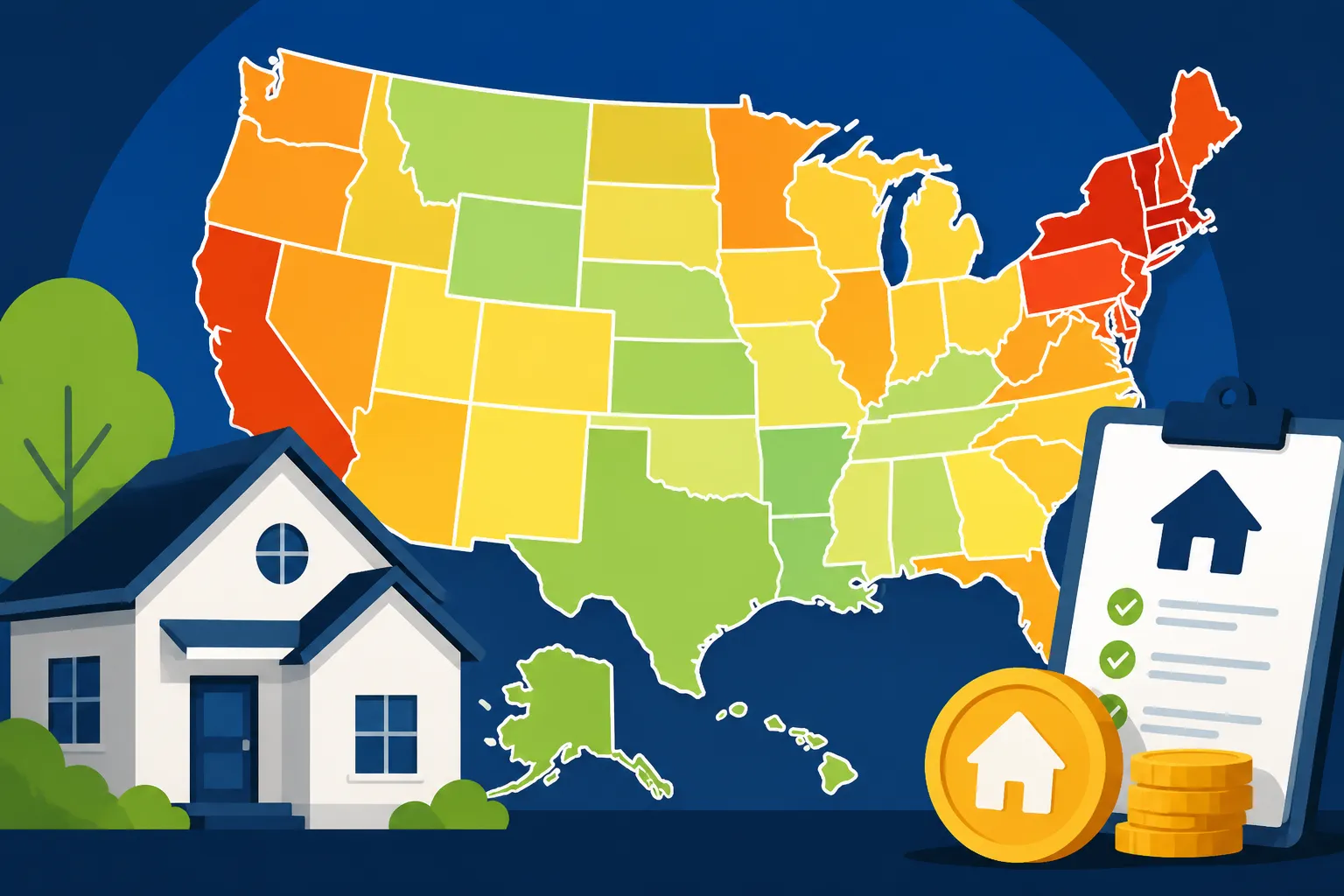
When you are browsing listings in a new area, always ask yourself: "What is the effective rate here?" If the effective rate is 2.5%, a $500,000 home is going to cost you $12,500 a year just in taxes. In a state with a 0.5% rate, that same $500,000 home only costs you $2,500 in taxes. Over a 30-year mortgage, that is a $300,000 difference. That is why checking the Property Tax Rates by State: Effective Rate Map is the most important step in your relocation research.
High Tax States: The Heavy Hitters
There is no sugarcoating it: some states are just expensive places to own property. Usually, these are states in the Northeast and the Midwest. These areas tend to have high-quality public services, well-funded school districts, and robust infrastructure, but all of that comes at a steep price. If you live in these regions, you are likely very familiar with the "tax blues" every time the mail arrives in January or October.
The Northeast Corridor: NJ, NY, and CT
New Jersey consistently takes the crown for the highest property taxes in the nation. It is not uncommon to see effective rates hovering around 2.5% or higher. If you live in Bergen or Essex County, you already know that your tax bill can sometimes feel like it is as high as your mortgage principal. The New Jersey Property Tax Rate (Highest in US) is driven largely by the state’s reliance on local property taxes to fund its extensive network of independent school districts. Every little township has its own administration, its own police force, and its own school board, and homeowners are the ones picking up the tab.
New York and Connecticut are not far behind. While New York City itself has some unique tax structures, the surrounding suburbs in Westchester and Nassau counties face some of the Highest Property Taxes in the US (States, Counties, Cities). People often move to these areas for the prestige and the schools, but they quickly realize that the "cost of entry" is a tax bill that increases almost every year. It is a trade-off that many families accept, but it requires a very high income to sustain over the long haul.
The Midwest Leaders: Illinois and Ohio
Illinois often rivals New Jersey for the top spot on the "highest tax" list. If you are looking at homes in the Chicago suburbs, the Illinois Property Tax Rate (2nd Highest) is something you cannot ignore. Much like New Jersey, Illinois has a staggering number of local taxing bodies—more than any other state in the country. From park districts to mosquito abatement districts, every little agency wants a slice of your property value. It creates a cumulative effect that can make homeownership feel incredibly burdensome for middle-class families.
Ohio also sits on the higher end of the spectrum, particularly in metropolitan areas like Columbus, Cleveland, and Cincinnati. While home prices in Ohio are generally more affordable than in the Northeast, the effective tax rates are high enough to balance things out. Homeowners here often find that while their mortgage is low, their monthly escrow payment is heavily weighted toward the tax collector. Understanding Why Do Property Taxes Increase? is essential for residents in these states, as even small local budget shifts can result in a noticeable jump in your annual bill.
Texas: High Rates but No Income Tax
Texas is the great paradox of American property taxes. On one hand, there is no state income tax, which sounds like a dream. On the other hand, the state has to fund its roads and schools somehow, and they do that primarily through property taxes. This leads to the Texas Property Tax Rate Explained being one of the most searched topics for people moving to the Sunbelt. In popular areas like Austin, Dallas, and Houston, effective rates can easily exceed 2.2%.
The frustration in Texas often comes from the rapid appreciation of home values. If your house doubles in value over five years, your tax bill can grow at an alarming rate if you don't have the right exemptions in place. This is why residents are so protective of their Texas Homestead 10% Cap Explained, which limits how much the assessed value can rise each year. Without these protections, a booming real estate market would price many long-term residents right out of their own homes.
Low Tax States: Where Your Wallet Breathes
On the flip side, there are several states where the property tax burden is remarkably light. For many retirees or people working remotely, these states represent a "financial sanctuary." However, it is important to remember that a low property tax rate doesn't always mean a low overall cost of living. Often, these states make up the revenue through higher sales taxes, income taxes, or even "hidden" fees like high vehicle registration costs.
The Deep South: AL, MS, and LA
If you are looking for the absolute lowest property taxes in the country, the Deep South is where you want to be. Alabama consistently ranks at the bottom of the list, often with effective rates below 0.40%. For a $250,000 home in Alabama, you might pay less than $1,000 a year in taxes. This is one of the primary reasons many people find the Lowest Property Tax States 2027 so attractive for retirement. The cost of carrying a home is simply lower than anywhere else.
Mississippi and Louisiana follow a similar trend. In Louisiana, the generous homestead exemption means that many lower-priced homes pay almost nothing in property taxes. While this is great for the individual homeowner’s budget, it often means that local services like roads and public schools are not as well-funded as they are in higher-tax states. It is a "you get what you pay for" scenario that every potential resident needs to weigh carefully.
Mountain West Gems: Colorado and Utah
Colorado is a bit of a surprise to many people. Despite having some of the most expensive real estate in the country, particularly in places like Denver and Boulder, its effective property tax rates are incredibly low, usually under 0.55%. This is largely due to state laws that limit how much of the tax burden can fall on residential property owners. If you are moving from a state like New York, the property tax bill on a $1 million home in Colorado might feel like a clerical error—it is that much lower.
Utah is another state where the tax burden is relatively low, often hovering around 0.60%. The state has a very efficient system for managing its assessments, and the strong economy helps spread the tax burden across commercial and industrial properties, taking some of the weight off homeowners. For families looking for a balance of outdoor lifestyle and fiscal responsibility, these Mountain West states are hard to beat.
Hawaii: The Outlier
Hawaii is the ultimate statistical anomaly. It has the lowest effective property tax rate in the entire United States, often around 0.28%. You might think this makes it the cheapest place to live, but as we all know, Hawaii has some of the highest real estate prices in the world. A tiny, 1,000-square-foot bungalow might cost $1.5 million. Even with a tiny tax rate, you are still paying a significant amount in dollars because the base value is so high.
Furthermore, Hawaii has an incredibly high cost of living for everything else, from groceries to electricity. This perfectly illustrates why you cannot look at property tax rates in a vacuum. You have to look at the whole picture. If you are curious about how Hawaii compares to the mainland, checking the Property Tax Rates by State: Effective Rate Map shows just how much of an outlier the Islands really are.
State Property Tax Comparison Table
To give you a better sense of how these numbers play out in the real world, here is a comparison of several states based on their 2026 projected effective tax rates and the estimated annual bill for a $400,000 home.
| State | Effective Tax Rate | Annual Bill ($400k Home) | Primary Funding Source |
|---|---|---|---|
| New Jersey | 2.47% | $9,880 | Local Schools & Municipalities |
| Illinois | 2.23% | $8,920 | Over 6,000 Local Taxing Units |
| Texas | 1.80% | $7,200 | Schools (No State Income Tax) |
| New York | 1.73% | $6,920 | High-End County Services |
| Florida | 0.86% | $3,440 | Tourism & Sales Tax |
| California | 0.75% | $3,000 | Limited by Proposition 13 |
| Colorado | 0.51% | $2,040 | Commercial Property Levies |
| Alabama | 0.39% | $1,560 | Low Local Spending |
Regional Trends and Economic Factors
Why is there such a massive gap between Alabama and New Jersey? It isn't just about politics; it is about how these states were built and how they choose to fund their future. Understanding these regional trends can help you predict where taxes might be headed in the future.
The Trade-off Between Income Tax and Property Tax
Most states need a certain amount of revenue to function, and they usually get it from one of three buckets: income tax, sales tax, or property tax. States like Texas, Florida, and Washington have no state income tax, so they lean heavily on property taxes or sales taxes to make up the difference. This is why you will often see that Why Are Texas Property Taxes So High? is a common complaint. It is simply the price you pay for not having a state income tax return to file every April.
Conversely, states like Maryland or Massachusetts have more "balanced" tax systems where they take a little bit from every bucket. This often leads to a more stable revenue stream for the state, but it can feel like you are being "nickeled and dimed" from every direction. When you are looking at the Property Tax Rates by State: Effective Rate Map, you are only seeing one-third of the total tax story.
Funding Schools and Public Services
In the United States, public schools are primarily funded by local property taxes. This is why property taxes are often so much higher in areas with prestigious school districts. When you buy a home in a "top-rated" district, you aren't just paying for the house; you are paying a subscription fee for that school system through your tax bill.
I have seen many retirees get frustrated because they are still paying $15,000 a year in property taxes for a school system their children haven't used in twenty years. This has led to many states implementing Senior & Over-65 Property Tax Exemptions and Freezes to help long-term residents stay in their homes. Without these programs, the very people who built the community would be forced out by the rising costs of the services they no longer use.
Impact of Home Value Appreciation
Property taxes are a "lagging" expense. When home values in a neighborhood explode—like we saw in many parts of the country recently—the tax bills don't always jump immediately. However, once the local assessor catches up, the increase can be staggering. If your home was valued at $300,000 and it is suddenly worth $600,000, even a "low" tax rate is going to result in a massive bill.
Some states have tried to protect homeowners from this "sticker shock" by implementing assessment caps. For example, California Prop 13 Explained (2% Cap) is one of the most famous (and controversial) tax laws in the country. It prevents the assessed value of a home from rising more than 2% per year, regardless of how much the market value increases. This creates a situation where two neighbors living in identical houses might pay vastly different tax bills simply because one bought their house in 1995 and the other bought theirs in 2024.
Managing and Comparing Your Taxes
So, what can you do with all this information? Whether you are staying put or planning a move, being proactive about your property taxes is the best way to protect your financial health. You don't have to just sit back and accept whatever bill the county sends you.
Using an Effective Rate Map for Relocation
If you are thinking about moving, use the Property Tax Rates by State: Effective Rate Map as a filter. If you know you want to keep your housing costs under a certain percentage of your income, some states will immediately be off the table. But don't just look at the state level; look at the county and city levels too. Even within a low-tax state, there can be "pockets" of high taxes due to local bonds or special taxing districts.
I always recommend that buyers look at the actual tax history of a property they are interested in. Don't just trust the "estimated" tax on a real estate website. Go to the county assessor’s website and look at the actual dollars paid over the last three years. This will give you a much clearer picture of the Property Tax Trends 2026 in that specific neighborhood. It is the only way to avoid a nasty surprise after you close on the deal.
How Assessments Influence the Final Bill
The rate is only half of the equation; the assessment is the other half. If your local government decides your home is worth more than it actually is, you are going to overpay, even if the tax rate stays the same. Many homeowners don't realize that they have the right to challenge their assessment. If you think the county has overvalued your home, you can file an appeal.
Learning How to Lower Your Property Tax Assessment can save you thousands of dollars over the life of your homeownership. It usually involves showing the assessor "comps"—similar homes in your area that sold for less than your assessed value. It takes a bit of work, but in high-tax states like Illinois or New Jersey, it is often one of the highest-return activities you can do for your personal finances.
Property Tax Disclaimer
Property tax rates, laws, and exemptions are subject to frequent changes by state and local governments. The figures provided in this guide are estimates based on current trends and should be used for informational purposes only. Always consult with a qualified tax professional or your local county assessor's office to confirm the exact rates and rules applicable to your specific property.